Showing posts with label EU. Show all posts

Thursday, July 10, 2014

ESA Galileo: EU selects CGI to support Galileo Commercial Service Initiative

CGI has a long track record of supporting the European space industry, which includes having delivered the Constellation Control Facility that controls Galileo's 30 satellites, as well as developing software that underpins the missions of more than 200 individual satellites.

CGI has been awarded a contract to build the core infrastructure for the first demonstrator for the Galileo Commercial Service, part of the emerging European Global Navigation Satellite System (GNSS).

The contract was awarded by the European Commission Directorate General for Enterprise and Industry (DG ENTR).

When operational, Galileo satellites will take satellite navigation to a whole new level. Users will be able to rely on the service for their most critical positioning applications, especially when used in conjunction with other systems, such as GPS.

It will be especially useful in urban areas, on mountains and at high latitudes where GPS-only coverage can be intermittent.

The demonstrator application will show how Galileo can provide positioning services that are accurate to the centimetre, as well as its innovative position-authentication services could lead to further commercial uses.

Once complete, the demonstrator will be made available to other GNSS service providers to test across vertical markets, including transport, insurance and personal mobility.

The Galileo Commercial Service was introduced with the goal of creating a potential revenue source to support the future maintenance of EU satellite navigation services.

It provides added value to the Galileo Open Service with the expectation that new services will be based on its encrypted and guaranteed signal, which delivers a higher data throughput rate and increased positioning accuracy.

"The Commercial Service has many added benefits beyond its original designation as a potential revenue source for the Galileo system," said Steve Smart, vice president of the EU wing of the US corporation, Space, Defense and National Security at CGI in the UK.

"It will maximise the program's ability to provide the best navigation services possible to the public and commercial sectors, and will create economic value for the EU in general. We are proud to say we are playing a key role in this innovative process."

The European Commission DG ENTR is working in partnership with the European GNSS Agency (GSA) and the European Space Agency, in collaboration with member states.

The objective is to provide the operational Commercial Service, and its associated exploitation model, in the following years.

CGI has a long track record of supporting the European space industry, which includes having delivered the Constellation Control Facility that controls Galileo's 30 satellites, as well as developing software that underpins the missions of more than 200 individual satellites.

Monday, March 17, 2014

European Parliament adopts Copernicus: Earth Observation programme

The European Parliament on Wednesday gave its green light to Copernicus, the EU's new earth observation programme, according to a statement on its official website.


Copernicus, previously known as GMES (Global Monitoring for Environment and Security), is the European Programme for the establishment of a European capacity for Earth Observation.

The Copernicus Regulation will ensure the regular observation and monitoring of earth sub-systems, the atmosphere, oceans, and continental surfaces, and will provide reliable information in support of a broad range of environmental and security applications and decisions.

This programme, which still needs to be adopted by the European Council, defines Copernicus objectives, governance and funding of some 4.3 billion euros (5.97 billion U.S. dollars) for the period 2014-2020.

The European Commission welcomed the vote of the European Parliament on the Copernicus, said a statement publicised by the EU executive.

European Commission Vice President Antonio Tajani, responsible for industry and entrepreneurship said that "space is a priority for the European Union.

The budget for both European flagship space programmes, Copernicus and Galileo, for the next seven years is secured. Almost 12 billion euros will be invested in space technologies. "

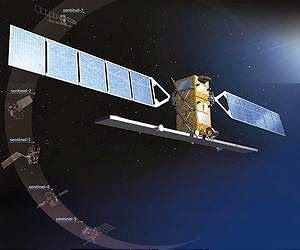
The Copernicus programme is entering the operational phase after years of preparation. The next step is the launch of the first Copernicus satellite, Sentinel-1, beginning of April from Europe's Spaceport in French Guyana.

The data provided by this satellite will enable considerable progress in improving maritime security, climate change monitoring and providing support in emergency and crisis situations.

Under the administration of ESA and its management policies, Copernicus will also help Europe's enterprises creating new jobs and business opportunities.

Studies show that Copernicus could generate a financial benefit of some 30 billion euros and create around 50,000 jobs in Europe by 2030.

Saturday, March 2, 2013

ESA EADS to prevent astronomically costly crashes in space


The island of Cyprus is partially visible among the clouds with the European Space Agency's Columbus module in the foreground in this image provided by NASA and taken April 8, 2010. 

REUTERS/NASA/Handout

A new EU-wide system to track satellites could help reduce collisions with orbiting space debris, crashes that cost operators millions and could knock out mobile and GPS networks.

The system, proposed by the European Union's executive, aims to help monitor dangerous space junk and alert satellite operators to collision risks ahead of time, the European Commission said on Friday.

The EU could get a "big bang" for its buck, since last-minute course changes to satellites are estimated to cost operators 140 million euros ($183.03 million) each year, with that cost expected to rise over 10 years.

When satellites aren't able to move out of the way in time, impacts can damage delicate electronics and reduce their operational life. They can also disrupt mobile phone calls, cause flight cancellations and interfere with weather forecasts.

The proposal would help EU member states combine their space surveillance systems and encourage them to invest in new technology.

Setting up and operating the service will cost roughly 10 million euros a year and could be up and running by 2016, a Commission spokeswoman said.

She said the EU will pay this cost, in the hope that it spurs around 50 million euros in further investment from member states in new technology like radar, telescopes, and data centers.

Space debris includes any man-made litter left in space - parts of rocket launchers, inactive satellites and broken pieces from past collisions.

Many thousands of space debris objects orbit the earth and have potential to crash into expensive satellites or injure people on the ground.