Showing posts with label ISS-RapidScat wind-watching scatterometer. Show all posts

Thursday, September 25, 2014

ISS Giant Earth Observation Satellite

Astronauts aboard the International Space Station (ISS) photographed this striking view of Pavlof Volcano on May 18, 2013. 

The oblique perspective from the ISS reveals the three dimensional structure of the ash plume, which is often obscured by the top-down view of most remote sensing satellites.

The International Space Station has been called a stepping stone to other worlds.

NASA hasn't forgotten, however, that the behemoth space station is also on the doorstep of Earth.

"We're seeing the space station come into its own as an Earth-observing platform," says Julie Robinson, chief scientist for the International Space Station Program.

"It has a different orbit than other Earth-observing satellites. It's closer to Earth, and it sees Earth at different times of day with a different schedule."

In short, the space station offers something unique to the study of our home planet.

Sometimes astronauts in low Earth orbit to see what regular satellites do not. In May 2013 for example, astronauts on board the International Space Station photographed a fresh eruption of the Pavlof Volcano in the Aleutian Islands.

Their oblique perspective revealed the three dimensional structure of the ash plume, which was only 20,000 feet high, but many times longer. Down-looking satellites could not get the same kind of 3D information.

Low Earth orbit turns out to be a great place to study the planet below. In recent years astronauts trained to photograph Earth have gathered data on desert dust, coral reefs, urban growth, pollution, glaciers, hurricanes, lightning, river deltas, volcanic plumes, Northern and Southern Lights and much more.

Now, however, NASA is taking the space station's Earth-observing capabilities to a whole new level.

Before the end of the decade, six NASA Earth science instruments will be mounted to the station to help scientists study our changing planet.
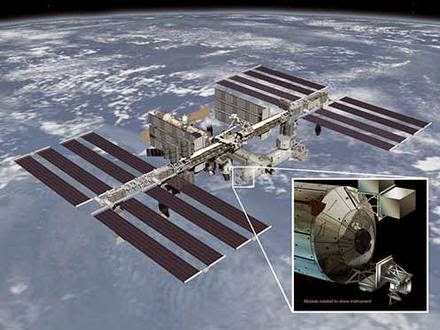
The upgrades began this month: On Sept. 20th, a SpaceX resupply rocket blasted off from Cape Canaveral carrying the first NASA Earth-observing instrument to be mounted on the exterior of the space station: ISS-RapidScat will monitor ocean winds for climate research, weather predictions and hurricane science.

Next up is the Cloud-Aerosol Transport System (CATS) a laser radar that can measure clouds along with airborne particles such as pollution, mineral dust, and smoke. CATS will follow ISS-RapidScat on another SpaceX flight targeted for December.

Two more Earth science instruments are slated to launch in 2016.

First, SAGE III will measure ozone and other gases in the upper atmosphere to help scientists assess how the ozone layer is recovering.

Second, the Lightning Imaging Sensor will monitor thunderstorm activity around the globe.

Those instruments are already built and ready to fly. In July, NASA selected proposals for two new instruments: The Global Ecosystem Dynamics Investigation (GEDI), and the ECOsystem Spaceborne Thermal Radiometer Experiment on Space Station (ECOSTRESS), will give scientists new ways to observe how forests and ecosystems are affected by climate change. Both will be completed before the end of the decade.

Monday, September 8, 2014

NASA Launches New Era of Earth Science from Space Station

Image Credit: NASA

The launch of a NASA ocean winds sensor to the International Space Station (ISS) this month inaugurates a new era of Earth observation that will leverage the space station's unique vantage point in space.

Before the end of the decade, six NASA Earth science instruments will be mounted to the station to help scientists study our changing planet.

The first NASA Earth-observing instrument to be mounted on the exterior of the space station will launch from Cape Canaveral Air Force Station, Florida, on the next SpaceX Commercial Resupply Services flight, currently targeted for no earlier than Sept. 19.

Graphic of ISS-RapidScat on ISS
ISS-RapidScat will monitor ocean winds for climate research, weather predictions and hurricane monitoring from the space station.

The second instrument is the Cloud-Aerosol Transport System (CATS), a laser instrument that will measure clouds and the location and distribution of airborne particles such as pollution, mineral dust, smoke, and other particulates in the atmosphere.

Graphic of CATS on ISS
CATS will follow ISS-RapidScat on the fifth SpaceX space station resupply flight, targeted for December.

"We're seeing the space station come into its own as an Earth-observing platform," said Julie Robinson, chief scientist for the International Space Station Program at NASA's Johnson Space Center in Houston.

"It has a different orbit than other Earth remote sensing platforms. It’s closer to Earth, and it sees Earth at different times of day with a different schedule."

"That offers opportunities that complement other Earth-sensing instruments in orbit today."

The space station-based instruments join a fleet of 17 NASA Earth-observing missions currently providing data on the dynamic and complex Earth system.

GPM image of Precipitation
ISS-RapidScat and CATS follow the February launch of the Global Precipitation Measurement Core Observatory (GPM), a joint mission with the Japan Aerospace Exploration Agency (JAXA), and the July launch of the Orbiting Carbon Observatory-2 (OCO-2), making 2014 one of the busiest periods for new NASA Earth science missions in more than a decade.

Most of the agency’s free-flying, Earth-observing satellites orbit the planet over the poles at altitudes higher than 400 miles in order to gather data from all parts of the planet.

Although the space station does not pass over Earth’s polar regions, its 240-mile high orbit does offer logistical and scientific advantages.

"With the space station we don't have to build a spacecraft to gather new data, it's already there,” said Stephen Volz, associate director of flight programs in the Earth Science Division at NASA Headquarters in Washington.

“The orbit enables rare, cross-disciplinary observations when the station flies under another sensor on a satellite. Designing instruments for the space station also gives us a chance to do high-risk, high-return instruments in a relatively economical way."

The data provided by ISS-RapidScat will support weather and marine forecasting, including tracking storms and hurricanes.

The station's orbit will allow the instrument to make repeated, regular observations over the same locations at different times of day, providing the first near-global measurements of how winds change throughout the day.

ISS-RapidScat was built by NASA's Jet Propulsion Laboratory (JPL) in Pasadena, California.

CATS is a laser remote-sensing instrument, or lidar, that measures clouds and tiny aerosol particles in the atmosphere.

These atmospheric components play a critical part in understanding how human activities such as pollution and fossil fuel burning contribute to climate change.

CATS was built by NASA's Goddard Space Flight Center in Greenbelt, Maryland.

Sunday, September 7, 2014

NASA's RapidScat payload

RapidScat's two-part payload is shown in the trunk of a SpaceX Dragon cargo spacecraft at NASA's Kennedy Space Center in Florida. 

Credit: NASA

NASA's ISS-RapidScat wind-watching scatterometer, which is scheduled to launch to the International Space Station no earlier than Sept. 19, will be the first science payload to be robotically assembled in space since the space station itself.

This image shows the instrument assembly on the left, shrouded in white.

On the right is Rapid-Scat's nadir adapter, a very sophisticated bracket that points the scatterometer toward Earth so that it can record the direction and speed of ocean winds.

The two pieces are stowed in the unpressurized trunk of a SpaceX Dragon cargo spacecraft at Cape Canaveral Air Force Station in Florida.

Howard Eisen, the ISS-RapidScat project manager at NASA's Jet Propulsion Laboratory, Pasadena, California, said, "Another mission had the idea of a two-piece payload first, but we beat them to the punch."

The RapidScat team designed and built both parts of the science payload in an 18-month-long sprint so as to take advantage of an available berthing space on the space station and a free ride on a resupply mission. The other two-piece payload is still a year and a half from launch.

Each piece of the ISS-RapidScat payload is attached to the space station by a standardized interface called a Flight Releasable Attachment Mechanism, or FRAM.

JPL's Stacey Boland, an engineer on the ISS-RapidScat team, explained, "The space station is almost like a Lego system, and a FRAM is a particular type of Lego block. We had to build on two separate Lego blocks because each block can only hold a certain amount of cargo."

Eisen noted, "We are not only robotically assembled, we are robotically installed." When the Dragon spacecraft reaches the station, a robotic arm will grapple it and bring it to its docking port.

Using a different end effector—a mechanical hand—the arm will first extract the nadir adapter from the trunk and install it on an external site on the Columbus module of the space station.

The arm will then pluck the RapidScat instrument assembly from the trunk and attach it to the nadir adapter, completing the installation. Each of the two operations will take about six hours.