Showing posts with label Space Science. Show all posts

Friday, February 15, 2013

ESA Columbus ISS Module Celebrates 5 Years of Space Science

NASA Astronauts John Olivas (left) and Nicole Stott, STS-128 mission specialists, in the mission's first spacewalk as construction and maintenance continue on the International Space Station. 

During the six-hour, 35-minute spacewalk, they removed an empty ammonia tank from the Station's truss and temporarily stowed it on the Station's robotic arm. 

They also retrieved the ESA experiments European Technology Exposure Facility (EuTEF) and Materials International Space Station Experiment (MISSE) from the Columbus laboratory module and installed them in Space Shuttle Discovery's payload bay for return. 

Credit NASA/ESA.

Since Europe's Columbus laboratory module was attached to the International Space Station five years ago, it has offered researchers worldwide the opportunity to conduct science beyond the effects of gravity.

A total of 110 ESA-led experiments involving some 500 scientists have been conducted since 2008, spanning fluid physics, material sciences, radiation physics, the Sun, the human body, biology and astrobiology.

NASA Astronaut Rex Walheim hanging on to Columbus

The Space Station allows researchers to play with a force that is fixed on Earth: gravity.

'Turning off' gravity and performing experiments in space over long periods can reveal the inner workings of natural phenomena.

"We focus research on achieving scientific discoveries, developing applications and benefitting people on Earth while preparing for future space exploration," explains Martin Zell, responsible for ESA's utilisation of the European orbital laboratory.

John Olivas
Studying colloids - tiny particles in liquids - is one area of research hampered by gravity. Colloids are found in many liquids such as milk, paint and even in our bodies, yet they are so small you need an electron microscope to study them. At this scale, gravity will always influence the results, but in space experiments can be run repeatedly without interference.

The Colloid experiment on Columbus has shown how 'quantum forces' can be used to control colloid structures. It confirmed the effect of these forces as predicted theoretically over 30 years ago, but observed for the first time in 2008. The findings are part of the building blocks for creating nano-materials.

Research inside Columbus is also helping scientists to understand the human body. Astronauts in space absorb more salt without absorbing more fluids - contradicting generally accepted medical knowledge.

Nicole Stott
It turns out that high-salt diets seem to be causing bone loss in astronauts. Until now, bone loss was thought to be caused by the physical effect of living in weightlessness. This new result has implications for people suffering from osteoporosis on Earth.

Delving deeper, cell research is offering clues on how to control ageing.

The Roald biology experiment revealed that certain enzymes in our immune systems are more active in space, showing scientists on the ground where to look to combat premature cell death.

There are also experiments mounted outside of the Columbus module. The first of a series of Expose experiments has shown that living organisms can survive space travel.

Saturday, June 9, 2012

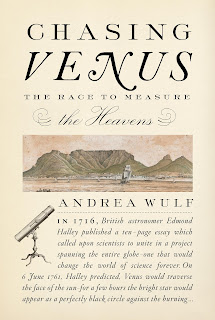
Chasing Venus: When the world came Together

In 1716, sixty-year old Sir Edmund Halley called on astronomers all over the world to leave their cozy observatories, travel to the edges of the known world, set up their telescopes, and turn their eyes toward the sunrise on the morning of June 6th, 1761, when the first Transit of Venus of the scientific age would march across the face of the sun.

In the eighteenth century, the solar system had a shape but not a size.

Captain Cook's 1792 Drawing
By timing the entrance and the exit of Venus across the sun from latitudes all over the world, Halley explained, astronomers could roughly calculate the distance between the Earth and the Sun — a “celestial yardstick” for measuring the universe, as Andrea Wulf calls it in her excellent book Chasing Venus: The Race to Measure the Heavens.

1882 Film of Venus transit
 It was the first worldwide scientific collaboration of its kind, a mathematical olympiad six hours in duration, with years of planning and seconds that counted.

Today, more than 250 years after this grand experiment that required astronomers all over the world to gather together and look to the sky at the exact same moment, we will experience the last transit of our lifetime (unless modern medicine makes us survive to December 2117, when the next one will take place).

Thursday, April 19, 2012

NASA's Swift Monitors Departing Comet Garradd

Swift's UVOT acquired this image of Comet Garradd (C/2009 P1) on April 1, 2012, when the comet was 142 million miles away, or 636 times farther than the moon. 

Red shows sunlight reflected from the comet's dust; violet shows ultraviolet light produced by hydroxyl (OH), a fragment of water. NGC 2895 is a barred spiral galaxy located 400 million miles away in the constellation Ursa Major. 

The UVOT image (outlined) is placed within a wider visible image of the region from the Digital Sky Survey. 

Credit: NASA/Swift/D. Bodewits (UMD) and S. Immler (GSFC) and DSS/STScI/AURA.

An outbound comet that provided a nice show for skywatchers late last year is the target of an ongoing investigation by NASA's Swift satellite. Formally designated C/2009 P1 (Garradd), the unusually dust-rich comet provides a novel opportunity to characterize how cometary activity changes at ever greater distance from the sun.

A comet is a clump of frozen gases mixed with dust. These "dirty snowballs" cast off gas and dust whenever they venture near the sun. What powers this activity is frozen water transforming from solid ice to gas, a process called sublimation. Jets powered by ice sublimation release dust, which reflects sunlight and brightens the comet. Typically, a comet's water content remains frozen until it comes within about three times Earth's distance to the sun, or 3 astronomical units (AU), so astronomers regard this as the solar system's "snow line."

"Comet Garradd was producing lots of dust and gas well before it reached the snow line, which tells us that the activity was powered by something other than water ice," said Dennis Bodewits, an assistant research scientist at the University of Maryland, College Park, and the study's lead investigator. "We plan to use Swift's unique capabilities to monitor Garradd as it moves beyond the snow line, where few comets are studied."

Comets are known to contain other frozen gases, such as carbon monoxide and dioxide (CO and CO2), which sublimate at colder temperatures and much farther from the sun. These are two of the leading candidates for driving cometary activity beyond the snow line, but phase transitions between different forms of water ice also may come into play.

C/2009 P1 was discovered by Gordon J. Garradd at Siding Spring Observatory, Australia, in August 2009. Astronomers say that the comet is "dynamically new," meaning that this is likely its first trip through the inner solar system since it arrived in the Oort cloud, the cometary cold-storage zone located thousands of AU beyond the sun.

Comet Garradd was closest to the sun on Dec. 23, 2011, and passed within 118 million miles (1.27 AU) of Earth on March 5, 2012. The comet remains observable in small telescopes this month as it moves south though the constellations Ursa Major and Lynx.

Although Swift's prime task is to detect and rapidly locate gamma-ray bursts in the distant universe, novel targets of opportunity allow the mission to show off its versatility. One of Swift's instruments, the Ultraviolet/Optical Telescope (UVOT) is ideally suited for studying comets.

The instrument includes a prism-like device called a grism, which separates incoming light by its wavelength. While Swift's UVOT cannot detect water directly, the molecule quickly breaks up into hydrogen atoms and hydroxyl (OH) molecules when exposed to ultraviolet sunlight. The UVOT detects light emitted by hydroxyl and other important molecular fragments - such as cyanide (CN), carbon monosulfide (CS) and diatomic and triatomic carbon (C2 and C3, respectively) - as well as the sunlight reflected off of cometary dust.

"Tracking the comet's water and dust production and watching its chemistry change as it moves deeper into the solar system will help us better understand how comets work and where they formed," said Stefan Immler, a researcher and Swift team member at NASA's Goddard Space Flight Center in Greenbelt, Md.

Tuesday, December 13, 2011

Microsoft co-founder Allen launches space project - Stratolaunch Systems

Microsoft Corp co-founder Paul Allen is planning to build a spaceship that could replace the Space Shuttle this decade.

Allen, 58, is hoping his new company, Stratolaunch Systems, will launch unmanned rockets from a flying carrier plane to ferry government and commercial payloads into space and back, and eventually evolve to human space missions.

The initiative comes only months after the United States retired the Space Shuttle program after 30 years, opening the door to private enterprise to supply space vehicles.

Allen's rocket will be launched from a massive carrier aircraft powered by six jumbo jet engines, to be constructed by Scaled Composites, a unit of defense contractor Northrop Grumman Corp.

The rocket itself will be made by private space company SpaceX, founded by Elon Musk, the billionaire co-founder of PayPal.

The first test flight is planned to happen within five years.


"I have long dreamed about taking the next big step in private space flight," said Allen in a statement. "To offer a flexible, orbital space delivery system."

Allen - listed by Forbes magazine as the world's 57th richest person, with a fortune of $13.2 billion - is the latest in a line of tech billionaires with interests in the privatization of space travel.

His space ambitions put him alongside Musk and Amazon.com founder Jeff Bezos, whose Blue Origin aims to put people into space at an affordable price, rather than the millions of dollars it has cost up to now.

Allen, who made up the name Microsoft, co-founded what became the world's biggest software company with Bill Gates in 1975.

Lacking Gates' single-minded drive for business success, he left Microsoft in 1983, as he dealt with a first battle with cancer. He recently survived a second course of treatment for a different type of cancer, but says he is healthy now.

Allen's interests and investments range far and wide, but are focused on his native Seattle and the Pacific Northwest.

He owns the Seattle Seahawks professional football team, the

Trail Blazers basketball team in Portland, and his investment firm developed much of the South Lake Union neighborhood which is central to Seattle's re-emergence as a technology center.

He is a generous donor to the University of Washington and is funding new research into the brain.

For leisure pursuits, he owns one of the world's largest yachts and built the Experience Music Project and Science Fiction Museum in Seattle. Allen's memoir, titled "Idea Man", was published earlier this year.

Friday, December 11, 2009

UK Forms a new Space Agency to Promote Space Science Projects

Described in a press release as both “recession-busting” and “bureaucracy-busting”, the new agency will takeover from the British National Space Centre (BNSC).

It will also incorporate six government departments, two councils, the Technology Strategy Board and the Met Office, all of which currently make up the UK’s space efforts.

Science and Innovation Minister Lord Drayson said in a statement: “The new space agency is about making sure that the UK fully exploits its competitive advantage in satellites, robotics and related technologies,“ he added.

The UK space sector has grown three times faster than the overall economy since 1999, racking up a nine per cent increase, and adding £6.5 billion a year to the economy. Some 65,000 people currently work in the sector.

“Our space sector hasn't missed a beat during this recession. This is the classic story of outstanding UK science and entrepreneurship continuing to create jobs and achieve exceptional growth,” he added.