Showing posts with label Transit of Venus. Show all posts

Saturday, June 9, 2012

Chasing Venus: When the world came Together

In 1716, sixty-year old Sir Edmund Halley called on astronomers all over the world to leave their cozy observatories, travel to the edges of the known world, set up their telescopes, and turn their eyes toward the sunrise on the morning of June 6th, 1761, when the first Transit of Venus of the scientific age would march across the face of the sun.

In the eighteenth century, the solar system had a shape but not a size.

Captain Cook's 1792 Drawing
By timing the entrance and the exit of Venus across the sun from latitudes all over the world, Halley explained, astronomers could roughly calculate the distance between the Earth and the Sun — a “celestial yardstick” for measuring the universe, as Andrea Wulf calls it in her excellent book Chasing Venus: The Race to Measure the Heavens.

1882 Film of Venus transit
 It was the first worldwide scientific collaboration of its kind, a mathematical olympiad six hours in duration, with years of planning and seconds that counted.

Today, more than 250 years after this grand experiment that required astronomers all over the world to gather together and look to the sky at the exact same moment, we will experience the last transit of our lifetime (unless modern medicine makes us survive to December 2117, when the next one will take place).

Thursday, June 7, 2012

2012 Venus Transit: AIA 171 Ingress - YouTube


The Venus transit was only the seventh since the first Venus transit seen by humans was recorded in 1639. There were no transits at all throughout the 20th century due to the timing of the events. This was the first Venus transit captured by humans from space, since astronaut Don Pettit, anticipating the event, brought a photographic solar filter with him to the International Space Station for that very purpose.

Wednesday, June 6, 2012

NASA - Transit of Venus 2012

The unique transit of Venus lasted for almost 7 hours.

Photo: NASA, photomontage: www.astroevents.no / Knut Jørgen Røed Ødegaard

NASA /ESA HubbleSite - Using the Moon as Mirror to See Venus Transit

This mottled landscape showing the impact crater Tycho is among the most violent-looking places on our Moon. Astronomers didn't aim NASA's Hubble Space Telescope to study Tycho, however.

The image was taken in preparation to observe the transit of Venus across the Sun's face on June 5-6.

Hubble cannot look at the Sun directly, so astronomers are planning to point the telescope at Earth's moon, using it as a mirror to capture reflected sunlight and isolate the small fraction of the light that passes through Venus's atmosphere. Imprinted on that small amount of light are the fingerprints of the planet's atmospheric makeup.

These observations will mimic a technique that is already being used to sample the atmospheres of giant planets outside our solar system passing in front of their stars. In the case of the Venus transit observations, astronomers already know the chemical makeup of Venus's atmosphere, and that it does not show signs of life on the planet.

But the Venus transit will be used to test whether this technique will have a chance of detecting the very faint fingerprints of an Earth-like planet, even one that might be habitable for life, outside our solar system that similarly transits its own star. Venus is an excellent proxy because it is similar in size and mass to our planet.

See the rest:


HubbleSite - NewsCenter

ESA Euronews: Unveiling Venus - YouTube


It can be called the morning or evening star, depending on where you are or what time it is, but it is anything but a star. In fact, it is one of our nearest planetary neighbours. Venus and Mars may be Earth's close cousins, but they are oh-so different. Only now are we starting to peer through Venus' clouds to reveal the burning planet's secrets.

NASA - 2012 Transit of Venus - Global Map

For Northern Hemisphere locations above latitude ~67° north, all of the transit is visible regardless of the longitude. Northern Canada and all of Alaska will also see the entire event.

Residents of Iceland are in a unique wedge-shaped part of the path (Region X in Figure 1).

They will see both the start and end of the transit but the Sun will set for a short period around greatest transit. A similarly shaped region exists south of Australia (Region Y in Figure 1), but here, the Sun rises after the transit begins and sets before the event ends.

NASA - 2012 Transit of Venus

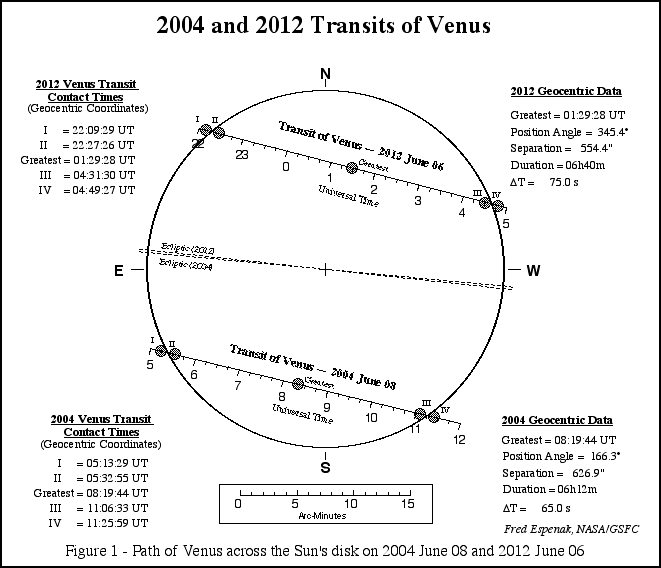
NASA - 2004 and 2012 Transits of Venus

Transits of Venus across the disk of the Sun are among the rarest of planetary alignments. Indeed, only six such events have occurred since the invention of the telescope (1631, 1639, 1761, 1769, 1874 and 1882). The next two transits of Venus will occur on 2004 June 08 and 2012 June 06.

The principal events occurring during a transit are characterized by contacts. The event begins with contact I which is the instant when the planet's disk is externally tangent with the Sun. The entire disk of the Venus is first seen at contact II when the planet is internally tangent with the Sun.

During the next several hours, Venus gradually traverses the solar disk at a relative angular rate of approximately 4 arc-min/hr. At contact III, the planet reaches the opposite limb and is once again internally tangent with the Sun.

The transit ends at contact IV when the planet's limb is externally tangent to the Sun. Contacts I and II define the phase called ingress while contacts III and IV are known as egress. Greatest transit is the instant of minimum angular separation between Venus and the Sun as seen from Earth's geocenter.

Figure 1 (Low Res or High Res) illustrates the geocentric observing geometry of each transit across the Sun (celestial north is up). The 2004 transit crosses the Sun's southern hemisphere while the 2012 event crosses the northern hemisphere.

The position of Venus at each contact is shown along with its path as a function of Universal Time. Each transit lasts over six hours. The apparent semi-diameters of Venus and the Sun are 29 arc-seconds and 945 arc-seconds respectively.

This 1:32.6 diameter ratio results in an effective 0.001 magnitude drop in the Sun's integrated magnitude due to the transit. Geocentric contact times and instant of greatest transit appear to the left corners of figure 1 (Low Res or High Res).

NASA - 2004 and 2012 Transits of Venus

Transit of Venus 2012: The last time until 2117


Stargazers from across the globe gathered together to watch one of the rarest astronomical spectacles today.

From the U.S. and UK to South Korea, people around the world turned their attention to the daytime sky to make sure they caught the planet Venus passing directly between the sun and Earth - a transit that won't occur again for another 105 years.

The transit of Venus happens in pairs eight years apart - but then with more than a century between cycles.

During the pass, Venus appears as a small, dark round spot moving across the face of the sun, like a bug on a dinner plate.


Drawing near - NASA, the SDO satellite captures the approach of Venus

Drawing near: In this handout image provided by NASA, the SDO satellite captures the approach of Venus before it transits across the face of the sun on June 5, 2012 from space

RHESSI Will Use Venus Transit to Improve Measurements of the Sun's Diameter

The RHESSI (Ramaty High Energy Solar Spectroscopic Imager) satellite focuses on the highest energy x-rays and gamma-rays produced by the sun, helping to observe solar flares of all shapes and sizes.

The satellite is pointed toward the sun, and constantly in rotation, which provides a serendipitous bit of side research: by monitoring the limb of the sun on its four second rotation cycle, RHESSI's Solar Aspect System (SAS) has produced ten years worth of precise measurements of the sun's diameter.

This has already provided scientists with one of the most accurate measurements of what's called the oblateness of the sun, which is the difference between the diameter from pole to pole and the equatorial diameter.

With the new data obtained during the Venus Transit on June 5-6, 2012, the RHESSI team hopes to improve the knowledge of the exact shape of the sun and provide a more accurate measure of the diameter than has previously been obtained.

For one thing, the sharpness of the Venus disk as it crosses the sun will help determine the detailed optical properties of the telescope and calibrate the instrument's so-called plate scale, the exact angular size of each pixel.

With this improvement in hand, RHESSI can re-calibrate its already highly accurate observations of the sun's horizon. To further this aim, the science team has set the instrument to look at 64 pixels across the sun's limb, rather than its customary four.

The RHESSI team has hopes that they may be able to provide an unprecedentedly accurate measurement of the sun's size.

The Mysterious Arc of Venus

The Arc of Venus. "I was flabbergasted when I first saw it during the 2004 transit," recalls astronomy professor Jay Pasachoff of Williams College. "A bright, glowing rim appeared around the edge of Venus soon after it began to move into the sun."

For a brief instant, the planet had turned into a "ring of fire."

Researchers now understand what happened. Backlit by the sun, Venus's atmosphere refracted sunlight passing through layers of air above the planet's cloudtops, creating an arc of light that was visible in backyard telescopes and spacecraft alike.

It turns out, researchers can learn a lot about Venus by observing the arc. Indeed, it touches on some of the deepest mysteries of the second planet.

"We do not understand why our sister planet's atmosphere evolved to be so different than Earth's," explains planetary scientist Thomas Widemann of the Observatoire de Paris.

Earth and Venus are similar distances from the sun, are made of the same basic materials, and are almost perfect twins in terms of size. Yet the two planets are wrapped in stunningly dissimilar blankets of air. Venus's atmosphere is almost 100 times more massive than Earth's and consists mainly of CO2, a greenhouse gas that raises the surface temperature to almost 900F.

Clouds of sulfuric acid tower 14 miles high and whip around the planet as fast as 220 mph. A human being transported to this hellish environment would be crushed, suffocate, desiccate, and possibly ignite.

For the most part, planetary scientists have no idea how Venus turned out this way.

"Our models and tools cannot fully explain Venus, which means we lack the tools for understanding our own planet," points out Widemann. "Caring about Venus is caring about ourselves."

One of the biggest mysteries of Venus is super-rotation. The whole atmosphere circles the planet in just four Earth days, much faster than the planet's spin period of 243 days. "The dynamics of super-rotation are still a puzzle despite a wealth of data from landmark missions such as NASA's Pioneer Venus, Russia's Venera and VEGA missions, NASA's Magellan and more recently ESA's Venus Express."

This is where the Arc of Venus comes in. The brightness of the arc reveals the temperature and density structure of Venus's middle atmosphere, or "mesosphere," where the sunlight is refracted.

According to some models, the mesosphere is key to the physics of super-rotation. By analyzing the lightcurve of the arc, researchers can figure out the temperature and density of this critical layer from pole to pole.

When the arc appeared in 2004, the apparition took astronomers by surprise; as a result, their observations were not optimized to capture and analyze the fast-changing ring of light.