Showing posts with label monkeys. Show all posts

Thursday, January 12, 2012

Rare Image: The Myanmar snub-nosed monkey

Researchers working in Northern Myanmar have captured the first photographs of the recently discovered Myanmar snub-nosed monkey.

"These images are the first record of the animal in its natural habitat," said Ngwe Lwin, the Burmese national who first recognised the monkey as a possible new species.

"It is great to finally have photographs because they show us something about how and where it actually lives."

"The Myanmar snub-nosed monkey was described scientifically in 2010 from a dead specimen collected from a local hunter," said Frank Momberg of FFI, who organised the initial expeditions that led to the monkey's discovery. "As yet, no scientist has seen a live individual," he added.

Picture: FFI/BANCA/PRCF/REX FEATURES

Sunday, January 8, 2012

Christopher Stringer: Rethinking "Out Of Africa"


CHRISTOPHER STRINGER: is one of the world's foremost paleoanthropologists.

He is a founder and most powerful advocate of the leading theory concerning our evolution: Recent African Origin or "Out of Africa".

He has worked at The Natural History Museum, London since 1973, collaborating with scientists across all the disciplines of paleoanthropology, and is a Fellow of the Royal Society, with over 200 papers and books to his name.

"At the moment, I'm looking again at the whole question of a recent African origin for modern humans—the leading idea over the last 20 years.

This argues that we had a recent African origin, that we came out of Africa, and that we replaced all of the other human forms that were outside of Africa.

But we're having to re-evaluate that now because genetic data suggest that the modern humans who came out of Africa about 60,000 years ago probably interbred with Neanderthals, first of all, and then some of them later on interbred with another group of people called the Denisovans, over in south eastern Asia.

If this is so, then we are not purely of recent African origin. We're mostly of recent African origin, but there was contact with these other so-called species.

We're having to re-evaluate the Out-of-Africa theory, and we're having to re-evaluate the species concepts we apply, because in one view of thinking, species should be self-contained units.

They don't interbreed with other species. However, for me, the whole idea of Neanderthals as a different species is really a recognition of their separate evolutionary history—the fact that we can show that they evolved through time in a particular direction, distinct from modern humans, and they separated maybe 400,000 years ago from our lineage

Morphologically we can distinguish a relatively complete Neanderthal fossil from any recent human.

You could argue that they're an extreme variant of Homo sapiens, but a very different 'race' from anyone alive today, or, as I prefer to argue, they're a separate species, with a separate evolutionary history.

I've never actually said that that meant they were completely reproductively isolated from us. We know that many closely related species in primates, for example, can interbreed.

Various species of monkey can interbreed and have fertile offspring, and so can our closest living relatives, Bonobos and common chimpanzees.

In my view the Neanderthals were closely related and probably potentially able to interbreed with modern humans, but until recently I considered that while there could have been interbreeding forty or fifty thousand years ago, it was on such a small scale that all trace of it vanished in the intervening years.

It now seems from Neanderthal genome studies that that was not so. We do have a bit of Neanderthal in us, you and I, it's a small amount, but certainly not negligible.

Does that mean Neanderthals are a different species or does it mean we should include them in Homo sapiens?

Well, they are still only a small part of our makeup now, reflecting something like a 2.5% input of their DNA. Physically, however, they went extinct about 30,000 years ago.

They had distinct behaviour and they evolved under different conditions from us, so I still think it's useful to keep them as a separate species, even if we remember that that doesn't necessarily preclude interbreeding."

Read more of this fascinating article here at EDGE: Rethinking 'Out of Africa' - Includes a Video and audio transcript.

Saturday, October 15, 2011

FARS: Iran Fails Attempt to Launch Monkey Into Space

Safir-2 rocket launch in February 2009
An Iranian attempt to launch a rocket carrying a live monkey into space in September has failed.

The mission, announced last summer in the website of the Iranian Space Agency, consisted in launching a capsule with a life support system and reentry capability on top of a Kavoshgar-5 rocket to an altitude of 120 kilometers for a 20-minute sub-orbital flight.

Deputy Science Minister Mohammad Mehdinejad-Nouri has reportedly commented: ”The Kavoshgar-5 rocket carrying a capsule with a live animal (a monkey) was launched during Shahrivar (Note: Shahrivar is an Iranian calendar month spanning August 23 to September 22). However, the launch was not publicised as all of its anticipated objectives were not accomplished.”

The launch of a live animal into space was considered “strategic, and a priority,” by the Iranian government.

In 2010, the country launched a Kavoshgar-3 rocket carrying a rat, two turtles and a worm into space.

According Hamid Fazeli, head of Iran’s Space Organisation, the plan to fly live monkeys has been put on hold indefinitely: ”One cannot give a set date for this project and as soon as our nation’s scientists announce the readiness (of the project) it will be announced,” he said.

The Iranian republic, which put a satellite into orbit successfully in 2009, is pursuing an ambitious space program, which poses concerns in the Western world for possible links to the development of nuclear capable ballistic missiles.

Monday, October 10, 2011

First two-way interaction between a primate brain and a virtual body

In a first-ever demonstration of a two-way interaction between a primate brain and a virtual body, two monkeys trained at the Duke University Center for Neuroengineering learned to employ brain activity alone to move an avatar hand and identify the texture of virtual objects.

“Someday in the near future, quadriplegic patients will take advantage of this technology not only to move their arms and hands and to walk again, but also to sense the texture of objects placed in their hands, or experience the nuances of the terrain on which they stroll with the help of a wearable robotic exoskeleton,” said study leader Miguel Nicolelis, MD, PhD, professor of neurobiology at Duke University Medical Center and co-director of the Duke Center for Neuroengineering.

Without moving any part of their real bodies, the monkeys used their electrical brain activity to direct the virtual hands of an avatar to the surface of virtual objects and, upon contact, were able to differentiate their textures.

Although the virtual objects employed in this study were visually identical, they were designed to have different artificial textures that could only be detected if the animals explored them with virtual hands controlled directly by their brain’s electrical activity.

The texture of the virtual objects was expressed as a pattern of minute electrical signals transmitted to the monkeys’ brains. Three different electrical patterns corresponded to each of three different object textures.

Because no part of the animal’s real body was involved in the operation of this brain-machine-brain interface, these experiments suggest that in the future patients severely paralyzed due to a spinal cord lesion may take advantage of this technology, not only to regain mobility, but also to have their sense of touch restored, said Nicolelis, who was senior author of the study published in the journal Nature on October 5, 2011.

“This is the first demonstration of a brain-machine-brain interface (BMBI) that establishes a direct, bidirectional link between a brain and a virtual body,” Nicolelis said

“In this BMBI, the virtual body is controlled directly by the animal’s brain activity, while its virtual hand generates tactile feedback information that is signaled via direct electrical microstimulation of another region of the animal’s cortex.”

“We hope that in the next few years this technology could help to restore a more autonomous life to many patients who are currently locked in without being able to move or experience any tactile sensation of the surrounding world,” Nicolelis said.

“This is also the first time we’ve observed a brain controlling a virtual arm that explores objects while the brain simultaneously receives electrical feedback signals that describe the fine texture of objects ‘touched’ by the monkey’s newly acquired virtual hand,” Nicolelis said.

Read more of this article here

Space debris: Beware of Scams and Quick Fixes

Read more marvellous cartoon fun from Ape not Monkey.com

Saturday, July 23, 2011

The origin of malaria: The hunt continues

The greater spot-nosed monkey, Cercopithecus nictitans. (Credit: © Jean-Louis Albert, CIRMF, Gabon)


The agent of malaria has been found in the greater spot-nosed monkey, also known as putty-nosed monkey (Cercopithecus nictitans), a small African primate derived from a line different to that of humans, gorillas and chimpanzees.
This discovery challenges current thinking on the origin of the parasite and introduces a key element in the fight against malaria: knowing how it has adapted to the human species will make it possible to target its weaknesses.
This work stems from research carried out by CNRS researchers in association with other organizations and is published on the 4 July 2011 in the journal PNAS.

Malaria, also known as paludism, is one of the greatest global scourges. This pathology, which causes a million human deaths each year, is especially rampant in Africa. The question of whether the primary infection originated from rodents or birds has long remained unanswered. Also found in gorillas, it was thought that the parasite was specific to hominids.

By working on the subject, a team of CNRS researchers headed by Franck Prugnolle and François Renaud of the Laboratoire MIVEGEC(1)(CNRS/IRD/Université Montpellier, jointly with the Centre International de Recherches Médicales de Franceville in Gabon, and in collaboration with other organizations, has demonstrated the presence of Plasmodium falciparum, the agent of malaria, in the greater spot-nosed monkey (Cercopithecus nictitans), a small African monkey derived from a line different to that of humans. The origin of the parasite probably predates the origins of the African hominids line.

The presence of Plasmodium falciparum in this Old World Monkey opens the way to the analysis of the genome of the parasite found in this species. Comparing its sequence with that (already known) of falciparum in humans will enable researchers to discover the molecular signatures of the human parasite and to find out how it has adapted to humans. Knowing the weaknesses of the parasite will be a major asset in combating malaria.

Thursday, October 21, 2010

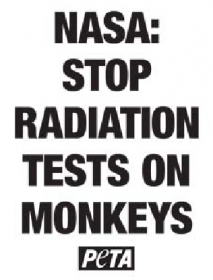
PETA protest against NASA's plans to irradiate Squirrel monkeys


NASA plans to to continue with plans to subject squirrel monkeys to gamma-ray radiation to learn how long space trips might affect humans.

The People for the Ethical Treatment of Animals
has obtained documents discussing a controversial NASA-funded project that would expose squirrel monkeys to radiation.

PETA obtained the documents, which include a draft "Decision regarding the disposition of the NSRL Proposal N-249," through a Freedom of Information Act request; however, the documents do not resolve the future of the space radiation experiment, which would take place at Brookhaven National Laboratory.

Citing an exemption under the federal law, the U.S. Department of Energy redacted essentially all of the content of the emails and the draft decision it forwarded to PETA.

A statement on PETA's website read: "Unfortunately, before the government sent us these documents, it blacked out Brookhaven's decision, so we don't know if plans to hurt these animals are moving forward or not."

A decision is pending, a spokesman for Brookhaven National Laboratory reported but the time frame was not available.

Full story on PETA's website

April Evans, a NASA aerospace engineer working on the International Space Station as a team lead, has quit her job over NASA's decision to irradiate non-human primates after 30 peaceful years without any space-related experiments on monkeys.

Evans, a NASA Space Flight Awareness Honoree, wrote to Brookhaven director Samuel Aronson, explaining, "After much deliberation, I resigned from NASA because I could not support the scientific justification for this monkey radiobiology experiment."

In the letter, Evans also encouraged the agency to develop better space radiation shielding to protect astronauts—instead of tormenting animals.

It’s also interesting to know that although NASA defends its use of radiation on primates, the European Space Agency does not conduct research on these creatures and has no plans or interest to.

In a letter dated April 1 formally stating the position of the European agency, director Jean-Jacques Dordain said, “there is absolutely no research interest or planning for experiments with primates.”

Wednesday, August 4, 2010

The Mandrill using colour to attract a partner

A photo of a mandril, which can use body odour to identify potential mates, researchers have found, in a study which lends new support to the theory that humans also have the ability to 'sniff out' suitable partners. The findings, which are reported by an international team of scientists in a paper today, suggest that scent and smell play a far more pivotal role in primates' mate selection than previously thought

A photo of a mandril, which can use body odour to identify potential mates, researchers have found, in a study which lends new support to the theory that humans also have the ability to 'sniff out' suitable partners.

The findings, which are reported by an international team of scientists in a paper today, suggest that scent and smell play a far more pivotal role in primates' mate selection than previously thought

Monday, June 14, 2010

Stop NASA's Plans to Expose Monkeys to Radiation | PETA.org

Stop NASA's Plans to Expose Monkeys to Radiation PETA.org

For many people, NASA represents cutting-edge science and grandiose achievements like sending a human to the moon. Unfortunately, future NASA plans are not so inspiring.

NASA has announced that it plans to fund a $1.75 million project in which up to 30 squirrel monkeys will be exposed to a large, harmful dose of radiation and then be locked in steel cages without any companionship.

They will be forced to endure years of behavioural tests to measure the inevitable devastation that the radiation causes to their brains and bodies, which would likely include brain damage, skin inflammation, blindness, various types of cancer, including brain tumors, and premature death.

Because of drastic biological differences between species, radiation experiments on monkeys won't tell scientists anything about how astronauts will react to deep space. Luckily, modern in vitro and clinical research methods are available and can be used to study the affects of space radiation on the human body.

In the past, NASA has halted plans to use monkeys in space experiments when the public spoke out against this cruelty, and animals need your support once again. Please contact NASA officials and politely ask them to permanently halt plans to fund radiation experiments using monkeys and to instead direct their funds to modern and humane methods of scientific inquiry.

Monday, December 21, 2009

War-torn 'nursery' hopes to send monkeys to Mars

The monkeys at this run-down research centre which was once the pride of Soviet science have seen it all -- a brutal civil war, freezing winters and starvation.

Now, if the scientists at the Institute of Experimental Pathology and Therapy have their way, one of these furry apes could someday be plucked from its cage and sent on a pioneering mission to Mars.

"We have plans to return to space," declared Zurab Mikvabia, the director of this institute nestled in a lush forest on a hill overlooking the Black Sea coast of Abkhazia, a breakaway region of ex-Soviet Georgia.

Residents of the Abkhaz capital Sukhumi call this place the "monkey nursery" and proudly recall how it produced groundbreaking medical research and raised two rhesus monkeys, Yerosha and Dryoma, sent into space in 1987.

But the institute fell on hard times after the collapse of the Soviet Union as Abkhazia fought a war to break free of Georgian control and fell into a long period of economic isolation.

Hundreds of apes died or disappeared during the 1992-93 war as Abkhaz separatists and Georgian troops fought over Sukhumi, an elegant seaside town famed as a resort in Soviet times.

"Many monkeys were shot. They were let out of their cages and just ran around the city," said Aldona, an institute employee who doubles as a tour guide for visitors.

Hunger and illness killed many more. There are now 350 apes, mostly baboons and macaques, confined in grim outdoor cages. The pre-war population was about 1,000 in Sukhumi plus thousands more at other branches of the institute.

At least a few dozen more monkeys are believed to be living in the wooded mountains of Abkhazia, descendants of a 1970s experiment where scientists released apes into the wild.

Testifying to the institute's glory days, a Soviet-era statue of a baboon stands in the central courtyard amid weeds and dry fountains.

In recent years, conditions for the apes have improved somewhat as Abkhazia enjoyed an investment boom, largely due to Russia, which recognised the region as an independent state in 2008 after a brief war with Georgia.

Only Nicaragua, Venezuela and the Pacific island nation of Nauru have joined Russia in recognising Abkhazia's independence, while the rest of the world considers it part of Georgia.

Mikvabia said the institute had improved the monkeys' diet and would soon start moving them from cages to large open-air enclosures where they would be able to run more freely.

"It's not normal to keep monkeys in small cages," said Mikvabia, a respected Abkhaz doctor who was appointed director of the institute in July.

As he smoked a pipe in his office, Mikvabia expressed his determination to bring serious science back to the institute after years when it essentially became a zoo for gawking tourists.

The institute is in preliminary talks with Russia's Cosmonautics Academy about preparing monkeys for a simulated Mars mission that could lay the groundwork for sending an ape to the Red Planet, Mikvabia said.

Such an initiative would build on Mars-500, a joint Russian-European project that saw six human volunteers confined in a capsule in Moscow for 120 days earlier this year to simulate a Mars mission.

"Earlier this programme was aimed at sending cosomonauts, people (to Mars)," Mikvabia said.

"But given the length of the flight to Mars, and given the cosmic rays for which we don't have adequate protection over such a long trip, discussions have focused recently on sending an ape instead of a person."

Estimates for the length of the journey to Mars vary depending on the type of mission envisioned, but the European Space Agency says its proposal for a round-trip mission would take 520 days, or about a year and a half.

If Russia pursues the idea of sending monkeys to Mars, Mikvabia's institute could become the site of an enclosed "biosphere" where apes would be kept for long periods to simulate spaceflights.

In a twist reminiscent of science fiction, the project would also include a robot designed to take care of the imprisoned ape.

"The robot will feed the monkey, will clean up after it. Our task will be to teach the monkey to cooperate with the robot," Mikvabia said.

History shows, however, that monkeys and technology can be a volatile combination.

Yerosha, perhaps the institute's best-known ape, freed a paw on his 13-day spaceflight in 1987 and started fiddling with buttons and tearing sensors off his body, much to the consternation of scientists on the ground.

Today's mission planners are determined to prevent such monkey business on the much longer and costlier trip to Mars.

"Technicians have told us that it's not difficult to build such a robot," Mikvabia said. "The hard part is teaching the monkey to live with the robot."

Wednesday, September 16, 2009

Gene therapy cures colour-blind monkeys - health - New Scientist

Gene therapy cures colour-blind monkeys - health - 16 September 2009 - New Scientist

Two colour-blind monkeys nicknamed Dalton and Sam have been "cured" through gene therapy.

The breakthrough could be a prelude to new gene treatments for human vision disorders that currently result in blindness. And because the treated monkeys were "middle aged", it challenges the assumption that gene therapies cannot work in adults because their brain connections are too set in their ways to change beneficially.

A human gene injected into the monkeys' eyes enabled them for the first time to produce Clong-wavelength opsin" the pigment sensitive to red and green light. "That gave them a retina like that of a normal person with full colour vision," says Jay Neitz at the University of Washington in Seattle.

The team used squirrel monkeys because the males are known to be colour-blind, whereas females have full colour vision. Males do have a full set of colour-sensing "cone" cells in their eyes, but they only make pigments for detecting blue and yellow light, making them blind to red and green.

Shared via AddThis

Friday, May 29, 2009

Betrayal by Vietnamese Wildlife farms

Restaurant workers skinning a crocodile. But is it from a farm or from the wild? (Image: AFP/Getty Images)

Restaurant workers skinning a crocodile from a Wildlife farm that pretends to protect endangered species (Image: AFP/Getty Images)

WILDLIFE farms are supposed to promote conservation by providing a sustainable alternative to hunting animals in the wild. But those in Vietnam are having exactly the opposite effect, says a study by the Wildlife Conservation Society (WCS) in New York.

Over the past two decades, dozens of commercial wildlife farms have sprung up in Vietnam. WCS investigators and Vietnamese officials who visited 78 farms undercover found that half had taken original breeding stock from wild populations, and 42 per cent were still doing so.

Animals farmed include snakes, turtles, crocodiles and monkeys. Worst affected are species such as tigers and bears, whose body parts or secretions are valued in traditional medicine. Not only are they slow to breed, but farms can also be used to launder products from animals killed in the wild.

Wildlife farmers should have to prove the source of their animals, and penalties for breaching wildlife laws should be increased, the WCS concludes.