Showing posts with label difficult. Show all posts

Monday, February 10, 2014

NASA MRO HiRise: Flowing water on Mars difficult to prove

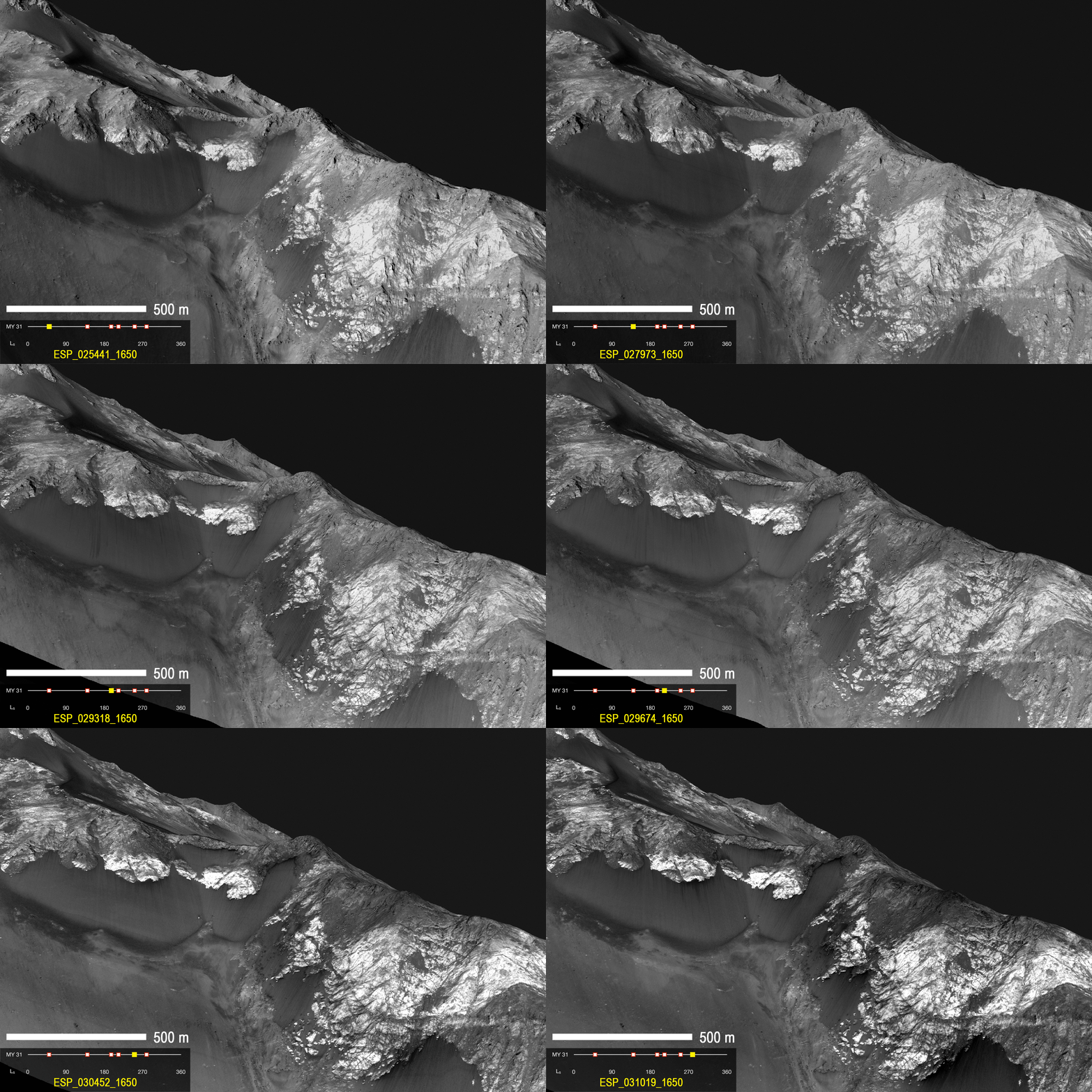
Dark flow-like features called Recurring Slope Lineae emanating from bedrock exposures at Palikir crater on Mars during southern summer. 

These flows are observed to form and grow during warm seasons when surface temperature is hot enough for salty ice to melt, and fade or completely disappear in cold season. 

Arrows point to bright, smooth fans left behind by flows. 

Credit: NASA/JPL

Martian experts have known since 2011 that mysterious, possibly water-related streaks appear and disappear on the planet's surface.

Georgia Institute of Technology Ph.D. candidate Lujendra Ojha discovered them while an undergraduate at the University of Arizona.

Lujendra Ojha
These features were given the descriptive name of recurring slope lineae (RSL) because of their shape, annual reappearance and occurrence generally on steep slopes such as crater walls.

Ojha has been taking a closer look at this phenomenon, searching for minerals that RSL might leave in their wake, to try to understand the nature of these features: water-related or not?

Ojha and Georgia Tech Assistant Professor James Wray looked at 13 confirmed RSL sites using Compact Reconnaissance Imaging Spectrometer for Mars (CRISM) images.

They didn't find any spectral signature tied to water or salts. But they did find distinct and consistent spectral signatures of ferric and ferrous minerals at most of the sites.

The minerals were more abundant or featured distinct grain sizes in RSL-related materials as compared to non-RSL slopes.

"We still don't have a smoking gun for existence of water in RSL, although we're not sure how this process would take place without water," said Ojha.

"Just like the RSL themselves, the strength of the spectral signatures varies according to the seasons. The signatures are stronger when it's warmer and less significant when it's colder."

The research team also notes that the lack of water-related absorptions rules out hydrated salts as a spectrally dominant phase on RSL slopes.

For example, ferric sulfates have been found elsewhere on Mars and are a potent antifreeze.

If such salts are present in RSL, then they must be dehydrated considerably under exposure to the planet's conditions by the time CRISM observes them in the mid-afternoon.

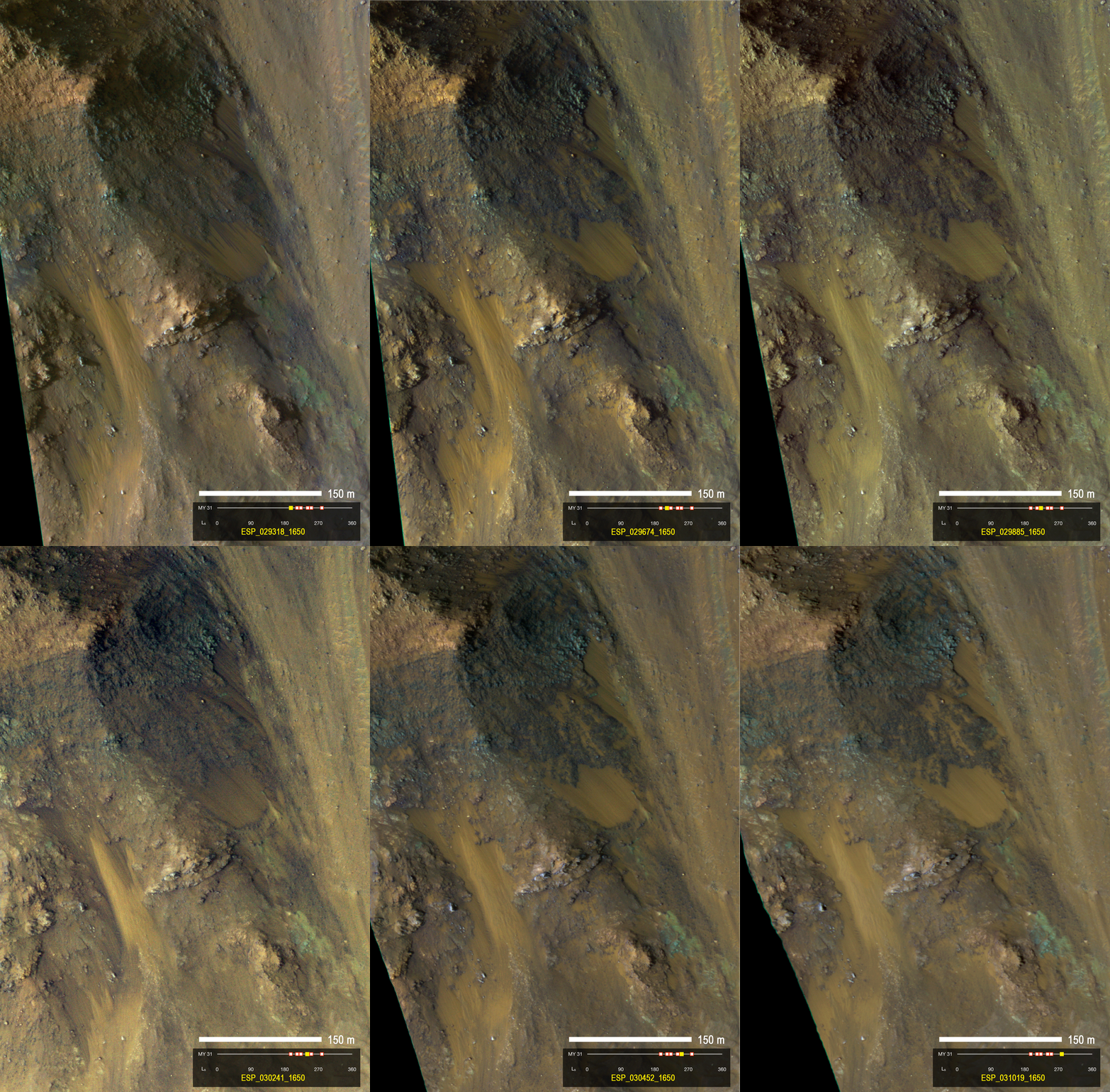
Dark elongated streaks called Recurring Slope Lineae observed in HiRISE images of Mars. 

The RSL form on sun facing slopes during warm season and fade during cold season. 

Credit: NASA/JPL

The findings were recently published in Geophysical Research Letters, and the Georgia Tech duo's newest paper, published in the journal Icarus, indicates that predicting where RSL will appear is, at best, a guessing game.

Ojha, Wray, and several Arizona-based colleagues looked at every image gathered by the High Resolution Imaging Science Experiment (HiRISE) from March to October of 2011.

They hunted for areas that were ideal locations for RSL formation: areas near the southern mid-latitudes on rocky cliffs. They found 200, but barely any of them had RSL.

"Only 13 of the 200 locations had confirmed RSL," said Ojha. "There were significant differences in abundance and size between sites, indicating that additional unknown factors such as availability of water or salts may play a crucial role in RSL formation."

Comparing their new observations with images taken in previous years, the team also found that RSL are much more abundant some years than others. Water on Mars today seems elusive at best – there one year, gone the next.

"NASA likes to 'follow the water' in exploring the red planet, so we'd like to know in advance when and where it will appear," Wray said.

"RSL have rekindled our hope of accessing modern water, but forecasting wet conditions remains a challenge."

Ojha and Wray are also among several co-authors on another RSL-related paper published this month in Nature Geoscience.

Tuesday, March 19, 2013

Russian Ganymede Lander Mission more difficult than expected

Russia's proposed landing mission to Ganymede was discussed extensively last week at an international meeting hosted by the Space Research Institute of the Russian Academy of Sciences.

The mission to explore, and perhaps to drill, the Solar system's largest moon, presumably in close cooperation with the European Space Agency (ESA), would be a major challenge for Russia's space and science industries.

The project is generally approved, but success is far from assured.

The mission to Ganymede, now better known by the simple name of "Ganymede Lander", is the latest reincarnation of Russia's contribution to the Laplas project, promoted by the European Space Agency (ESA) in the early 2000s.

With Laplas becoming the single-spacecraft project JUICE (JUpiter ICy moon Explorer, until christened officially), Russian plans have also undergone major changes, although their main objective, sending a lander to Jupiter's biggest moon, remained intact.

The initial aim was to explore Europa, a smaller Jovian moon, where there is an ocean of liquid water beneath its frozen surface (around 10 km thick) and is therefore considered a good prospect for the exploration of habitable conditions.

Ganymede also holds liquid water, but much deeper, under an icy crust of around 130-150 km. On the other hand, this moon is farther from Jupiter with less radiation than Europa, putting spacecraft at a much lower risk.

However, the main argument for shifting to Ganymede was that the European mission now no longer plans to stay near Europa long enough to provide the high resolution images needed to select a landing site.

It is supposed now that the JUICE orbiting spacecraft will provide the Russian lander with preliminary reconnaissance data and perhaps act as a communication relay station for data sent between Ganymede and Earth.

Hence, the current scenario is that the European mission is developing independently while Russia's landing spacecraft has its own scientific payload and objectives.

As the success of the landing relies on many technical issues closely concerned with JUICE, the Russian equipment and goals must be taken into account from the start when designing the eventual lander.

A more detailed mission scenario was presented by Maksim Martynov, deputy general designer of the S.A. Lavochkin Association and head of the design bureau.

Following the "play safe" rule, it is supposed that Russia will send two spacecraft to Ganymede, a lander and a small additional orbiter to secure the landing site as a back-up option to information from JUICE.

Even though launched simultaneously from a Proton launcher, they will arrive separately. After reconnaissance and remote studies of the moon, the lander will be delivered to the surface to begin its studies.

The start is planned for 2022-23 with the completion in 2029-30 (JUICE is currently scheduled for 2022) and subsequent arrival on Ganymede within a few months.