Showing posts with label iPhones. Show all posts

Wednesday, April 4, 2012

NASA Kepler Explorer App Puts Distant Planets at Fingertips

Armchair explorers of the cosmos can now have at their fingertips the nearly 2,000 distant planetary systems discovered by NASA's Kepler Mission. Kepler Explorer, an innovative app for iPads and iPhones developed by a team at the University of California, Santa Cruz, provides interactive displays of newly discovered planetary systems based on Kepler data.

Now available for free from the iTunes App Store, Kepler Explorer was developed through the OpenLab initiative at UC Santa Cruz, which brought together faculty and students in astrophysics, art, and technology for a summer institute last year.

The Kepler Explorer team includes astrophysicist Jonathan Fortney, a member of the Kepler science team; two of his graduate students, Eric Lopez and Caroline Morley; artist Kyle McKinley, a recent graduate of the Digital Arts and New Media program; and John Peters, a recent graduate of the computer game design program.

"I learned a lot about astrophysics from this project. It was a lot of fun," said Peters, who wrote all of the software code for the app.

Fortney, an associate professor of astronomy and astrophysics at UCSC, said he enjoyed the opportunity to work on a project that could reach a wider audience than most of his research.

The team quickly settled on the idea to create an app, and also developed it into an exhibit that provides additional information and shows the app's output on a large screen.

The exhibit was part of two OpenLab public exhibitions last year, one at the UCSC Digital Arts Research Center and another at the Tech Museum in San Jose.

It is scheduled for long-term installation in the Lick Observatory visitors gallery later this month.

Kepler Explorer starts with drop-down menus listing all the Kepler-discovered planetary systems, plus our own solar system.

The selected system is displayed in a view that shows the planet or planets in their orbits around the host star.

Shown in real time the planets look motionless, but moving a slider increases the speed until the planets zip around their star.

The touch screen lets users zoom in and move around the system, and tapping on an individual planet brings it up for further exploration.

Another view shows the relative sizes of the individual planets compared to their host star.

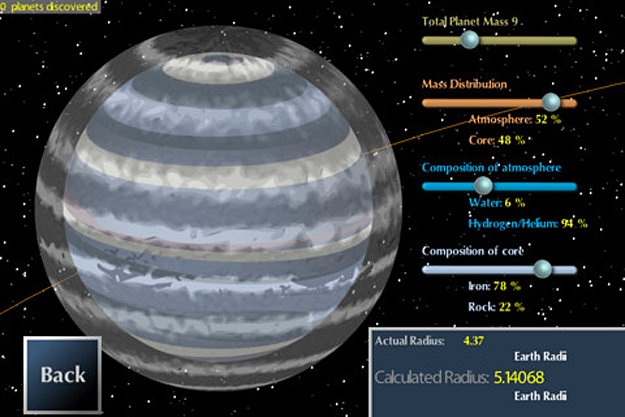
Kepler Explorer's most innovative features are seen when viewing individual planets. The user can manipulate the composition of the planet and its atmosphere and see which mixtures of components (iron, rock, water, and hydrogen) are consistent with Kepler's observations.

This feature represents graphically the type of in-depth analysis that Fortney does for the Kepler Mission. "I have pretty good intuition for what the likely composition of a planet is based on its size, but the app allows anyone to explore the properties of many different planets very quickly," he said.

Because Kepler detects planets as they pass in front of their host star, it only measures the radius of a planet, or how big it is. In most cases, the mass of the planet is unknown.

When the mass is unconstrained, there may be different combinations of components that result in a planet of a given size.

The app's interactive graphics show how this works. There are sliders for different components and how they are partitioned in the core and the atmosphere, and as you move the sliders the image of the planet grows and shrinks, based on hundreds of calculations.

As you change the settings, the app tells you when the size of your planet matches the observations. The calculations involved took hours of computer time, but the results are stored in tables so the app can use them on the fly.

"For a large-radius planet, you can very quickly tell that it can't be a rocky planet, for example, and that in itself is pretty informative," Lopez said.

So far, the Kepler Mission has detected a total of 2,321 planet candidates orbiting 1,790 host stars. Automatic updates for the Kepler Explorer app will add new planet candidates as they are discovered.

Jennifer Parker, an associate professor of art, started the OpenLab initiative in 2011 with astrophysicist Enrico Ramirez-Ruiz, who invited Fortney to participate, and recent graduates Amy Boewer and Jack O'Neill.

"We wanted to bring together faculty who are interested in interdisciplinary work with students from a range of disciplines," Parker said.

"There is such a vast amount of research on this campus, and one way to share it with the public is to make tangible things and playable media. It's not just about art illustrating science.

OpenLab is creating a space for new ways of thinking that can emerge from conversations between different disciplines."

Saturday, January 14, 2012

Street View App: Mars' Surface Taken from Rover Opportunity

A new app that provides stunning images of the Martian surface taken by a NASA rover currently exploring the planet has been released for iPhone and Android devices.

The free Mars Images app – created by computer scientist Mark Powell of NASA’s Jet Propulsion Laboratory – allows users to browse archived and new pictures taken from The Opportunity Mars Exploration Rover, which has been on Mars since 2004.

The rover has been snapping pictures of the surface and making big discoveries, such as finding evidence that water was once on the planet, since its arrival.

NASA plans to add images to the archive of Opportunity’s sister rover, The Spirit. Both Spirit and Opportunity were put on Mars in January 2004 to conduct a 90-day mission of exploration, but the rovers stayed well past their mission time.

Although the Spirit’s mission ended in mid-2011, Opportunity continues to explore Mars’s surface today.

The six-wheeled vehicles – which are controlled by NASA employees on Earth – feature various cameras to take images of Mars and its surface, such as navigation, panoramic, hazard-avoidance and microscopic imaging cameras to take pictures of small rocks.

The app will also send pictures to directly to mobile devices once new ones become available.

Image courtesy of NASA via Powellware.com

Wednesday, December 14, 2011

GPS with Android and WiFi on its way

The world's first handheld GPS to use the Android mobile operating system is here.

The All Sports GPS from Holux is also the first handheld unit with WiFi capability.

The idea is to fuse smartphone capability into a handheld GPS, allowing users to download GPS apps directly without having to hookup to a computer.
 
The All Sports GPS is a cooperative effort between Taiwan's Holux, which manufactures GPS products, and Satski, a Canadian company best known for its winter sports apps.

So, it's not surprising that the GPS will come pre-loaded with the SatSki app and a companion suite that includes other sports apps for golf, biking, running and geo-caching, among other activities.

The apps provide all sorts of speed, distance, real-time location and navigation information. For winter sports fans, the Satski app uses resort trail maps.

There's also Facebook and Twitter integration and on online community at luvthesnow.com to share and boast about your greatest runs.

Another app included in the package is All Sports Maps, which allows users to download live maps, including Google, Nokia OVI, Open Street and Open Cycle, for later offline use, all for free.

Similar apps in the Android Market can run you as much as ten US dollars for something well-suited to backcountry use, out of the range of a data connection.

SatSki promises that the All Sports GPS will be a "rugged, highly sensitive IPX 6-rated unit" that also supports Bluetooth health monitor accessories. No word on an exact release date or pricing for the device, but the company promises it is "coming soon."

Monday, November 14, 2011

iPhone: Amazing spray coating can make it waterproof [video]


NeverWet on Electronics and Conformal Coatings from Ross Nanotechnology on Vimeo.

Neverwet, a new spray coating, can turn almost anything waterproof. Like seriously waterproof, as in messy sauces, juice, ink and oil don’t just bead off — they shoot off the surface.

It’s also anti-corrosive, sending even bacteria and ice running and screaming for the hills.

While there are a host of water-resistant coatings and products available, most only offer hydrophobic properties and fall short of the litmus test to be considered “waterproof.”

Ross Technologies claims that their silicon-based product is superhydrophobic, meaning it repels liquids at a very high “contact angle” (175 degrees), which is the distance wedged between a water droplet and the surface. So the higher the contact angle, the rounder the water droplet.

The secret to how the patent-pending technology works is a proprietary arrangement of nanoparticles that turns water droplets into near-perfect spheres.

Originally, researchers at the company had set about developing a material that would prevent steel from corroding and realized that such a product might also work on a variety of surfaces, including fabrics.

They eventually came up with a separate coating that can be applied just about anywhere.


To demonstrate Neverwet’s mighty water, stain and dirt-repelling abilities, the company has produced a series of mini-infomercials where spilled water scurries away in terror, chocolate syrup simply slides off a treated shoe and a coated iPhone is shown to still work while submerged underwater — even after half an hour.

The company says that the coating is exceptionally durable, stating on their website that “NeverWet™ coatings have remained under seawater for over a year and reemerged completely dry.”
The final product isn’t scheduled to hit the market until sometime next year.

Thursday, October 27, 2011

Prosthetic Limb With An Embedded Smartphone Dock Built In

Trevor Prideaux was having trouble texting. Prideaux, who was born without his left forearm, used to have to balance his smartphone on his prosthetic arm or lay it on a flat surface to text, dial, or otherwise take advantage of the technology.


So with some help form the Exeter Mobility Center in Devon, UK, the 50-year-old Prideaux has become the first person to have a smartphone dock embedded in his prosthetic limb.

With some design help from Nokia and the prosthetics team at EMC, Prideaux’s Nokia C7 is now fixed within his prosthetic forearm (he went to Apple first hoping to mount an iPhone, but Cupertino declined to participate in his project).


He can now easily text by using his one hand, or field calls either by putting his prosthetic forearm up to his ear or by using speakerphone, leaving his biological limb free.

The very idea of it gets the idea mill churning. Right now, the prosthesis is a prosthesis and the phone is simply a phone, but the idea of integrating the two opens the door to some unique possibilities.

Aside from being able to record data on how the limb is used to help designers better customize the prosthesis to the person, the limb could also be augmented to make better use of the phone/computer.

Maybe some extra battery on board the limb? Some speakers for better speaker phone usage (and for the wearer’s listening pleasure, should he or she require some tunes).

Call it primitive cyborg tech with a lot of potential.

Friday, October 21, 2011

Apple iPhone 4S: Using Russian Glonass GPS

The secret is out and making Russia proud: pop culture and geek tech icon Apple has picked Russia's Glonass navigation system to run alongside GPS in its iPhone 4S models that hit stores this month.

The news was not exactly hidden by the California-based firm. A scan through the iPhone "specs" page on the Apple website shows Glonass sitting conspicuously next to GPS in the global positioning column.

But the news has created a sensation on the Russian Internet and made the front page of the respected Vedomosti business daily on Thursday.

"If the iPhone 4S really does have Glonass navigation," the paper said in a disbelieving tone, "this would be the first time the Russian system reached the world market."

It then quoted a company spokesman as saying that the phones became 50 percent more reliable with the Russian invention on board.

Vedomosti said basic Glonass documentation has the same open access as GPS. The basic global positioning system is also being honed for more precise military use not available to consumers.

The Glonass system has struggled through many delays and cost overruns that was additionally hurt last year by the loss of three satellites in a botched launch.

Glonass is less precise than its rival but relies on a different set of satellites that could work in some cities where the US system is less effective.

Monday, November 22, 2010

Parrot AR drone video: Quadricopter controlled by an iPhone


They’re here and have been for some time. Smaller, commercialised versions of the pilotless drones that US forces and agencies deploy over world hot spots can now be purchased and used by used by consumers for £200 and up.

There are a lot of positives. Deliveries is one potential use of private drones. Equipped with cameras, they may help engineers scope sites, police fight crime, or firefighters save lives. Maybe they could be instrumental in keeping an eye on children or locating those that are lost, or finding lost hikers in the wilderness.

Unfortunately, some people are worried about the privacy and security implications. Celebrities are a prime target using paparazzi drones, but there may be all kinds of issues for the rest of us, privacy and otherwise.

The idea of citizens having their own ‘personal drone’ to ‘keep an eye on things’ may be a worrying sign for some.

The Wall Street Journal’s Siobhan Gorman reports commercial or personal drones will soon be flooding the market. “Several efforts to develop personal drones are scheduled for completion in the next year.” Gorman observes that “an unmanned aircraft that can fly a predetermined route costs a few hundred bucks to build and can be operated by iPhone.”

Consider such offerings as the Parrot AR drone, a quadricopter that can be controlled by an iPhone, iPod or iPad, or the swinglet Cam, a “flying camera” developed and marketed by senseFly in Switzerland.

The swinglet can fly for about 30 minutes up to 12 miles, providing capabilities such as aerial imagery, crop monitoring, land management, environmental monitoring, real estate, traffic monitoring, mapping, archeology, and wildlife monitoring.

Wednesday, June 30, 2010

Inside the iPhone 4's vibrational gyroscope

Apple first announced the iPhone 4’s gyroscope at WWDC 2010, but it was largely overshadowed by other big players inside the phone — the A4 processor, Retina display, and external antennas.
A lot of technology gets stuffed into vibrational gyroscopes (the type found in the iPhone 4), yet a casual observer may barely notice the chip itself, let alone the phenomenal contents within it. iFixit and Chipworks have partnered to show you exactly what’s inside these little gems.

Vibrational gyroscopes have a ton of practical uses, including automotive yaw sensors, game controllers, and image stabilization in cameras.


Now, iPhone 4 applications and games can also benefit from their superb accuracy.


The teardown covers not only the iPhone 4’s gyroscope, but vibrational gyroscopes in general.


We have tried our best to explain how vibrational gyroscopes function and have documented their internals at a microscopic level.

Some findings:

•The iPhone 4 utilizes a microscopic, electronic version of a vibrational gyroscope, called a MEMS gyroscope.
•A microelectromechanical system (MEMS) is an embedded system that integrates electronic and mechanical components at a very small scale.
•A basic MEMS device consists of an ASIC and a micro-machined silicon sensor.
•The AGD1 2022 FP6AQ chip found in the iPhone 4 is a MEMS gyroscope rumored to be designed by STMicroelectronics.
•Chipworks has confirmed that the MEMS gyroscope found inside the iPhone 4 is nearly identical to an off-the-shelf STMicroelectronics L3G4200D gyroscope.
•The picture (above) is that of the GK10A MEMS die, found in the L3G4200D.
•The GK10A is comprised of a plate, called the “proof mass,” that vibrates (oscillates) when a drive signal is applied to set of drive capacitor plates.
•When a user rotates the phone, the proof mass gets displaced in the X, Y, and Z directions by Coriolis forces. An ASIC processor senses the proof mass’ displacement through capacitor plates located underneath the proof mass, as well as finger capacitors at the edges of the package.

Monday, January 4, 2010

Chinese counterfeiting thrives despite crackdowns

Chinese counterfeiting thrives despite crackdowns

While China has talked up its recent progress in stamping out copyright piracy, the market for fake iPhones and bootleg DVDs still flourishes, and its trading partners say it could do better.

Late last month, the United States -- consistently critical of Beijing's failure to stop the illicit production of US brands -- issued an annual report saying piracy in the Asian giant remained at "unacceptably high levels".

Analysts say despite official crackdowns and successful prosecutions, graft and weak policing means factories continue to churn out fake goods, costing foreign and domestic firms billions of dollars in lost revenue.

"Local protectionism and government corruption are the real issue," Daniel Chow, a professor at the Ohio State University College of Law, told AFP.

"The central government is probably sincere but enforcement occurs at the local level, and local governments have a direct and indirect interest in protecting counterfeiting, which is important to the local economy."

Wednesday, September 16, 2009

China iPhone substitute to sell at top price

Lenovo Mobile is designing handsets for China's national 3G mobile standard that will sell for as little as US$150, but its high-end handset made to rival the iPhone is not one of them, the company said Wednesday.

The company's O1, the first handset that will use both the Chinese 3G standard and an operating system made by carrier China Mobile, has a display and a body that resemble the iPhone.
But while Chinese carriers aim to start drawing more 3G users with handsets that sell for around 1,000 yuan ($147), the O1 will "definitely not" fall in that price range, Chen Wenhui, marketing vice president for Lenovo Mobile, said at a press event.

"This is a high-end mobile phone for Internet use," Chen said.


China Unicom, which is racing with China Mobile and a third local carrier to attract 3G users, plans to start selling the iPhone in the fourth quarter, officially bringing the phone to a country where many wealthy urbanites already use versions of the handset bought overseas. The carrier has said it will offer both the iPhone 3G and the iPhone 3GS at "competitive" prices.

Lenovo Mobile has said it aims to start selling its rival to the iPhone this month. "The launch of the O1 symbolizes that competition between the Ophone and the iPhone has fully begun," the company said in a statement. "Ophone" is the nickname China Mobile has given to handsets that use its propriety mobile OS, which is based on Google's Android.

A report on local portal Tencent cited an unnamed source as saying the Lenovo Mobile phone will cost around 5,000 yuan, but that users will be able to buy it for 1,500 yuan if they also subscribe to China Mobile's 3G service. The first handset to launch with the China Mobile OS, a 2G version of the Magic handset from High Tech Computer (HTC), sells for 5,000 yuan.

At the press event, Lenovo Mobile displayed its iPhone rival and mock-ups of four lower-end handsets that will also use TD-SCDMA (Time Division Synchronous Code Division Multiple Access), the homegrown 3G mobile standard being promoted by China Mobile and Beijing. The lower-end handsets will sell for China Mobile's target price of 1,000 yuan, and one is slated to go on sale this year.

Lenovo Mobile is also working on its next 3G Ophone, which will target a younger audience and support Flash, executives said.

The O1 will come with a 3.5-inch touchscreen, 8GB or 16GB of storage and pre-installed China Mobile applications such as the carrier's instant messaging client, but the phone is compatible with most Android applications, Lenovo Mobile said.