Showing posts with label diamonds. Show all posts

Wednesday, December 17, 2014

30,000 Diamonds in one rock - Alrosa 's Udachnaya diamond mine

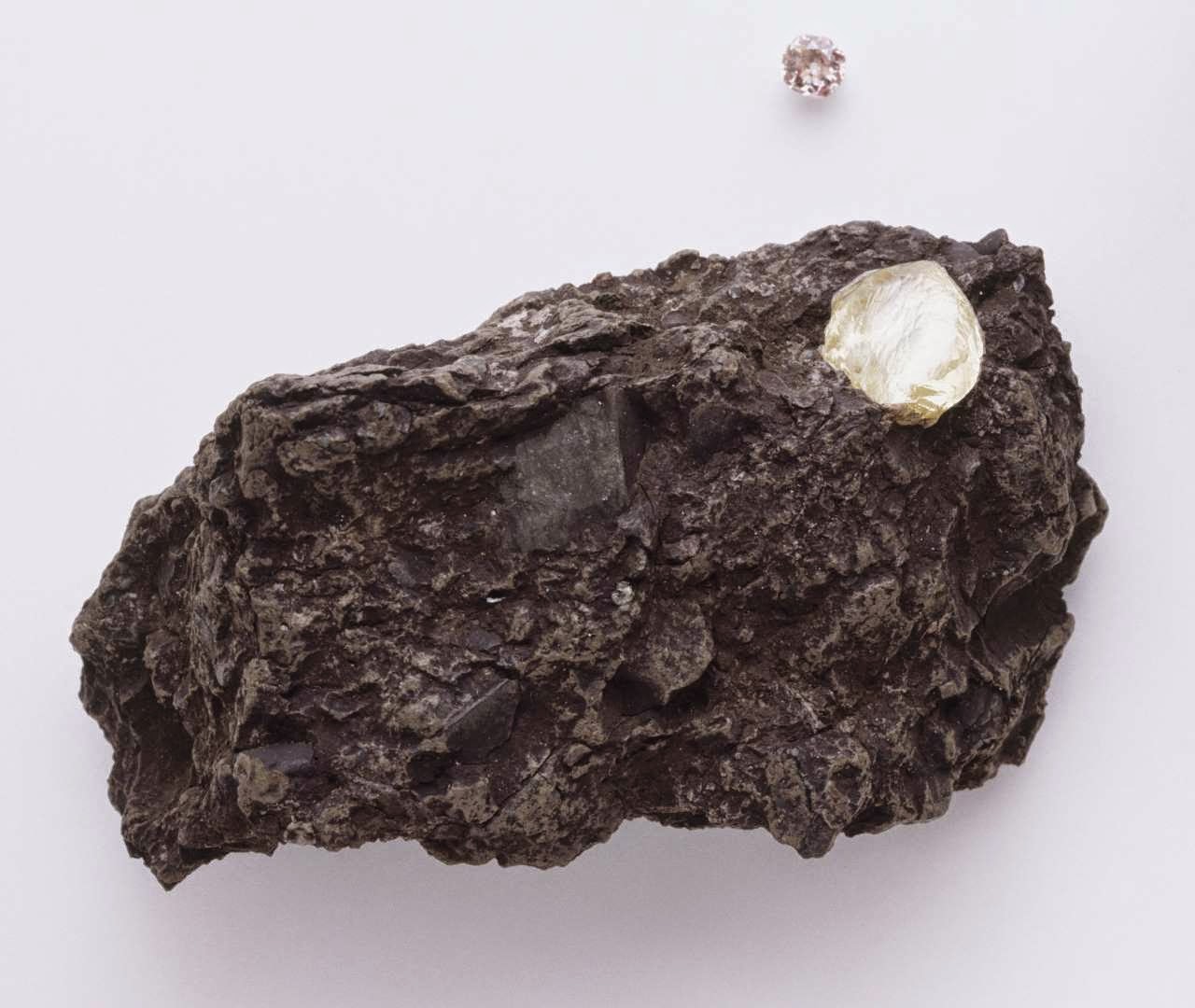
Strange rock containing 30,000 diamonds baffles science and the geologists.

Credit: Getty Images

When Russian miners pulled a strange red and green stone out of the ground, they immediately knew it was different to the thousands of tons of ore they process every day.

In fact, what workers at Alrosa 's Udachnaya diamond mine had unearthed was a 30mm rock that contained 30,000 diamonds, a concentration 1M times higher than normal.

However, despite the rare find the company donated the rock to the Russian Academy of Sciences, as the diamonds are so small that they cannot be used as gems.

After scanning the rock with X-rays, scientists found that the diamonds inside measure just 1mm and are octahedral in shape - similar to two pyramids stuck together at the base.

The red and green colouring comes from larger crystals of garnet, olivine and pyroxene.

"The exciting thing for me is there are 30,000 itty-bitty, perfect octahedrons, and not one big diamond," said Larry Taylor, a geologist at the University of Tennessee, who presented the findings at the American Geophysical Union 's annual meeting.

"It's like they formed instantaneously. This rock is a strange one indeed."

Scientists are excited at the finding as they hope it will shed further light on how diamonds are made.

They know diamonds are crystals of pure carbon that form under crushing pressures and intense heat, mostly formed in the Earth's mantle, the layer beneath the crust or surface layer, at a depth of about 150km. However, certain processes in their creation remain a mystery.

"The [chemical] reactions in which diamonds occur still remain an enigma," Mr Taylor told Live Science, which first reported the story.

Mr Taylor works with researchers at the Russian Academy of Sciences to study Udachnaya diamonds.

Russia is the largest diamond-producing country in the world, and produced more than 33m carats last year.

State-controlled Alrosa is the world's leading diamond miner, accounting for 99pc of Russia’s output and 27pc of global production. Its sees rough diamond revenues of more than $4bn a year.

Last week Alrosa signed a dozen deals with Indian buyers to increase direct deliveries to Asia's third-largest economy.

The firm earns half of its revenue, or around $2.5bn, from Indian-funded clients, and the deal could help Russia reduce risks linked to Western sanctions imposed over its role in the Ukraine crisis.

Last month Alrosa revealed a 10.5bn rouble (£110m) loss for its third quarter despite sales rising 7.6pc.

The Udachnaya mine, in the Sakha Republic, just outside the Arctic circle, is more than 600 metres deep, making it the third deepest open-pit mine in the world.

Monday, November 10, 2014

NASA Scientists Find Diamonds and in Sutter's Mill Gold Rush Meteorite

Fragments of the Sutter’s Mill meteorite fall collected by NASA Ames and SETI Institute meteor astronomer Peter Jenniskens in the evening of Tuesday April 24, 2012, two days after the fall. This was the second recovered find.

Image Credit: NASA Ames/Eric James

This is a secondary electron image of two large diamond crystals in the matrix of the Sutter's Mill number SM2 meteorite, as prepared by a focused ion beam. 

The origin of the diamonds is something of a mystery since they are considerably larger than those found in any chondritic meteorites.

Image Credit: NASA Johnson/M. Zolensky

The diamonds are transparent and colorless in this optical image of the same focused ion beam-prepared slice of Sutter's Mill number SM2.

Image Credit: NASA Johnson/M. Zolensky

Researchers digging deeper into the origins of the Sutter's Mill meteorite, which fell in California's Gold Country in 2012, found diamonds and other "treasures" that provide important new insight into the early days of our solar system.

They report their results in thirteen papers in the November issue of Meteoritics & Planetary Science.

"Sutter's Mill gives us a glimpse of what future NASA spacecraft may find when they bring back samples from a primitive asteroid,” said consortium lead Peter Jenniskens of the SETI Institute in Mountain View, California, at NASA’s Ames Research Center in Moffett Field, California.

"From what falls naturally to the ground, much does not survive the violent collision with Earth's atmosphere."

Jenniskens found one of the first and one of the most unusual of the Sutter's Mill meteorites before rain hit the area.

In his search, Jenniskens was guided by Marc Fries of NASA's Johnson Space Center, in Houston, who describes in detail how Doppler weather radar enabled the rapid and pristine collection of the meteorites.

"The two 10-micron diamond grains we found in this meteorite are too small to sparkle in a ring," said Mike Zolensky, space scientist of Johnson, working with associate professor Yoko Kebukawa late of Hokkaido University, Japan, "But their size is much larger than the nanometer-sized diamonds commonly found in such meteorites."

Nano-diamonds are thought to originate in the atmospheres of stars. The larger diamonds found in Sutter's Mill may have had another origin closer to home.

"We suspect that these diamonds are so-called xenoliths,” says Kebukawa. "Bits and pieces that originated in the interior of other much larger parent bodies."

University of California (UC), Davis researchers Akane Yamakawa and Qing-Zhu Yin studied the different forms of the element chromium, called isotopes.

They found that at least five different stellar sources composed of mixtures of 54-chromium-rich and -poor materials must have contributed matter to the nascent solar system four and half billion years ago. Some of these materials remained in the Sutter's Mill meteorite.

"The formation of the solar system did not fully erase and homogenise these signatures and Sutter’s Mill provides the clearest record yet," said Yin, also a co-lead of the Sutter’s Mill Meteorite Consortium.

Some fragments escaped alteration by liquid water, while others where heavily altered. Based on isotopes of the elements manganese and chromium, NASA Earth and Space Science Fellow Christine Jilly and colleagues now report when that happened.

"We determined that minerals such as calcium and magnesium carbonate likely precipitated from liquid water 2.4 to 5.0 million years after the formation of the solar system," says Jilly.

"It is possible that radioactive compounds in the meteorite's parent body heated the nascent planet to the point that water ice became liquid."

In primitive meteorites like Sutter's Mill, some grains survive from what existed in the cloud of gas, dust and ices that formed the solar system.

In Sutter's Mill, the liquid water appears to have destroyed the silicate type of these, according to Xuchao Zhao of the Chinese Academy of Sciences, working with NASA and UC Davis colleagues.

Wednesday, February 19, 2014

ESO Messier 7: Diamonds in the tail of the scorpion - Video

This new image from the Wide Field Imager on the MPG/ESO 2.2-metre telescope at ESO's La Silla Observatory in Chile, shows the bright star cluster Messier 7, also known as NGC 6475. 

Easily spotted by the naked eye in the direction of the tail of the constellation of Scorpius (The Scorpion), this cluster is one of the most prominent open clusters of stars in the sky and an important research target. 

Credit: ESO

A new image from ESO's La Silla Observatory in Chile shows the bright star cluster Messier 7.

Easily spotted with the naked eye close to the tail of the constellation of Scorpius, it is one of the most prominent open clusters of stars in the sky—making it an important astronomical research target.

Messier 7, also known as NGC 6475, is a brilliant cluster of about 100 stars located some 800 light-years from Earth.

In this new picture from the Wide Field Imager on the MPG/ESO 2.2-metre telescope it stands out against a very rich background of hundreds of thousands of fainter stars, in the direction of the centre of the Milky Way.

At about 200 million years old, Messier 7 is a typical middle-aged open cluster, spanning a region of space about 25 light-years across.

As they age, the brightest stars in the picture, a population of up to a tenth of the total stars in the cluster, will violently explode as supernovae.

Looking further into the future, the remaining faint stars, which are much more numerous, will slowly drift apart until they become no longer recognisable as a cluster.


Open star clusters like Messier 7 are groups of stars born at almost the same time and place, from large cosmic clouds of gas and dust in their host galaxy.

These groups of stars are of great interest to scientists, because the stars in them have about the same age and chemical composition. This makes them invaluable for studying stellar structure and evolution.

An interesting feature in this image is that, although densely populated with stars, the background is not uniform and is noticeably streaked with dust.

This is most likely to be just a chance alignment of the cluster and the dust clouds.

Although it is tempting to speculate that these dark shreds are the remnants of the cloud from which the cluster formed, the Milky Way will have made nearly one full rotation during the life of this star cluster, with a lot of reorganisation of the stars and dust as a result.

So the dust and gas from which Messier 7 formed, and the star cluster itself, will have gone their separate ways long ago.

Thursday, October 10, 2013

Scientists find Jupiter and Saturn are awash in diamonds

Recent work by planetary scientists has indicated that the deep atmospheres of Jupiter and Saturn may contain chunks of diamond floating in a liquid hydrogen/helium fluid.

Planetary scientists Mona L. Delitsky of California Specialty Engineering in Pasadena, California, and Kevin H. Baines of the University of Wisconsin-Madison have compiled recent data about the phase diagram of carbon and combined them with newly published adiabats (pressure-temperature diagrams) for Jupiter and Saturn to calculate that diamond will be stable in the deep interiors.

Further, at altitudes below the regions where diamond is stable, the pressures and temperatures will be so large as to melt the diamond into liquid, creating diamond rain or liquid diamond.

Recent publications by Nettelmann et al. (2008, 2011) have reported improved adiabats based on new equations of state for the materials inside of Jupiter and Saturn, and new experiments by researchers at Sandia Laboratories and Lawrence Livermore National Laboratory using shockwave techniques (notably those of Knudson et al. 2008 and Eggert et al. 2010) have given clear boundaries for the different phases of carbon.

Delitsky and Baines are reporting that elemental carbon such as soot or graphite generated in Saturn's enormous lightning storms will descend into the planet and will be crushed into diamonds at deep altitudes and then melted into liquid diamond near the cores of the planets.

While it has been known for 30 years that diamond may be stable in the cores of Uranus and Neptune, Jupiter and Saturn were thought to be too hot or to not have conditions suitable for precipitation of solid diamond.

The cores of Uranus and Neptune are too cold to melt diamond. The new data available has confirmed that at depth, diamonds may be floating around inside of Saturn, some growing so large that they could perhaps be called "diamondbergs."

In a recent book, Alien Seas, (Springer 2013), edited by renowned space artist Michael Carroll, a chapter by Baines and Delitsky entitled "The Seas of Saturn" was published. Using this new accurate data, a story about robot mining ships plying the deep interior of Saturn in the far distant future and collecting chunks of diamond was described.

The artwork (see images, below) shows robot hands reaching out to capture diamonds and collect them for transport to Earth.

Because of this new information, theorists Delitsky and Baines report that "diamonds are forever on Uranus and Neptune and not on Jupiter and Saturn."