Wednesday, March 26, 2014

New storms on Jupiter look like Mickey Mouse

A full view of Jupiter on February 25, 2014 showing several features including three storms that in combination look like Mickey Mouse. 

Credit: Damian Peach. 

We told you this was going to be a good season to observe Jupiter, and astro-photographers in the northern hemisphere have been making the most of this time of opposition where Jupiter has been riding high in the sky.

What we didn't know was that there was going to be a familiar face staring back at us.

A combination of three storms has been noted throughout this Jupiter observing season for its resemblance to Mickey Mouse's face (at least in outline).

Damian has also put together a stunning movie (below) showing about three hours of rotation of the king of the planets.


Damian explained the Mickey Mouse storms are two anticyclones (high pressure regions) that form the ears while a longer elongated cyclone (low pressure) forms the face.

The abundance of storms on Jupiter are a result of the planet's dense atmosphere of hydrogen and helium and large gravitational field. Storms on this planet are likely the strongest in the Solar System.

Jupiter reached its most northern point for 2014 at a declination of +23.3 degrees on March 11, but it's still easily visible since it is the brightest starlike object in the evening sky.

Jupiter’s Great Red Spot and the ‘Mickey Mouse’ storms on February 25, 2014. 

Credit: Damian Peach.

NASA LRO: Wet or Dry Moon

The Moon's status as a "dry" rock in space has long been questioned. Competing theories abound as to the source of the H20 in the lunar soil, including delivery of water to the Moon by comets.

This week, Tartèse et al announced in Geology that new analyses of lunar soil samples demonstrates that basalts from the Moon's mantle contain hydrogen from water indigenous to Earth.

According to the authors, their work is "challenging the paradigm of a "dry" Moon, and arguing that some portions of the lunar interior are as wet as some regions of the Earth's mantle."


This video from NASA Goddard shows how NASA’s Lunar Reconnaissance Orbiter (LRO) is helping scientists understand where water is likely to exist on the south pole of the Moon. 

Credit: NASA Goddard on YouTube

Since the 1960's, scientists have suspected that frozen water could survive in cold, dark craters at the Moon's poles.

While previous lunar missions have detected hints of water on the Moon, new data from the Lunar Reconnaissance Orbiter (LRO) pinpoints areas near the south pole where water is likely to exist.

The key to this discovery is hydrogen, the main ingredient in water: LRO uses its Lunar Exploration Neutron Detector (LEND), to measure how much hydrogen is trapped within the lunar soil.

By combining years of LEND data, scientists see mounting evidence of hydrogen-rich areas near the Moon's south pole, strongly suggesting the presence of frozen water.

More information: Romain Tartèse, Mahesh Anand, Francis M. McCubbin, Stephen M. Elardo, Charles K. Shearer, and Ian A. Franchi. "Apatites in lunar KREEP basalts: The missing link to understanding the H isotope systematics of the Moon." Geology, G35288.1, first published on February 25, 2014, DOI: 10.1130/G35288.1

ESA Sentinel-1: Environmental Monitoring Satellite fuelled, pressurised and ready for launch

ESA’s Sentinel-1A, the first satellite dedicated to Europe’s environmental monitoring Copernicus programme has been fuelled and pressurised, ready for its launch on 3 April.

Since its arrival in Kourou, French Guiana a month ago, Sentinel-1A has been put through a series of stringent tests.

As well as ensuring that this new satellite hadn’t incurred any damage during transit from France, the tests included the lengthy process making sure its batteries charge from the solar wings and then release energy to the satellite as needed, as they would do in space.

The latest preparations have focused on fuelling.

As this is an extremely hazardous task, the fuelling team has to wear special ‘scape suits’.

Pre-Launch Operations crew togged up in ‘scape suits’

Marking a milestone on the road to launch, the team finished loading the fuel last Friday and pressurised the tanks yesterday.

Svein Lokas, ESA’s Sentinel-1A Launch Campaign Manager, said, “The various teams have been working flat out to thoroughly test the satellite and all its components.

“We are very happy and relieved that we have reached this important milestone.”

ESA’s Sentinel-1 Project Manager, Ramón Torres, added, “After being involved in the Sentinel-1 mission for more than seven years, these last few days before launch are very rewarding.”

Assembling Soyuz

“It is thanks to the outstanding technical excellence and collaborative efforts from industry and ESA that have brought us to this point, and we all look forward to a successful launch on 3 April.

“Once safely in orbit around Earth, this new satellite will provide essential radar imagery for Europe’s Copernicus programme – a programme that will make a step change in the way we care for our planet.”

Sentinel-1 is defined by its advanced radar. Able to scan Earth’s surface no matter what the weather and regardless of whether it is day or night, it will be vital for numerous practical applications.

In crisis situations, it will be used for rapid response to disasters such as floods and earthquakes. Its radar will routinely monitor shipping zones, map sea ice and provide information on winds and waves for marine traffic, track changes in the way land is being used, and monitor subsidence.

NASA's Z-2 Spacesuit concepts: Futuristic Astronaut Suit Design

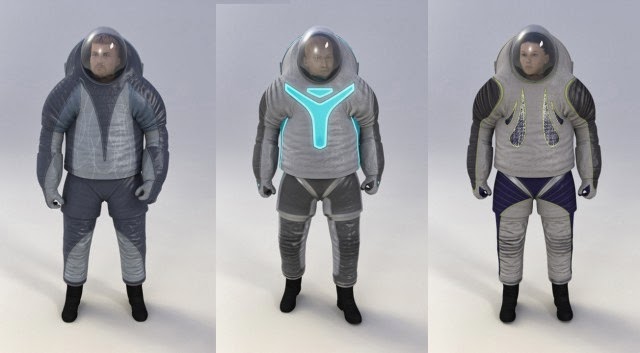
NASA Z2 "Trends in Society" spacesuit design is based on what every day clothes may look like in the not-too-distant future. 

The 'Trend in Society' suit uses electroluminescent wire and a bright colour scheme to mimic the appearance of sportswear and the emerging world of wearable technologies. 

The design specifically includes gore pleats with contrast stitching throughout to highlight mobility, an exposed bearing at the hip, and electroluminescent wire and patches of varying styles across both the upper and lower torso. 

Image released March 24, 2014.

The three NASA Z-2 designs are called Biomimcry, Technology, and Trends in Society (pictured above).

The Biomimicry suit draws on the fact that Earth’s oceans are quite similar to outer space: “Mirroring the bioluminescent qualities of aquatic creatures found at incredible depths, and the scaly skin of fish and reptiles found across the globe, this design reflects the qualities that protect some of Earth’s toughest creatures,” says the NASA Z-2 website.

The electroluminescent wire makes the astronaut visible in low-light.

The Technology suit is basically the same deal, but with a sci-fi design aesthetic instead.

The suits will also support the new rover-based suitport/suitdock concept, a new spin on airlocks, where the suit itself forms part of the airlock system.

If we ever send humans to Mars or Titan or some other extraplanetary body, rover-based suitports will likely be used.

Please visit Nasa Beyond Earth website to get all the latest updates and photos on the Z-2 and other advanced spacesuit news.

NASA JAXA GPM: First Images from GPM - Pacific Ocean Cyclone

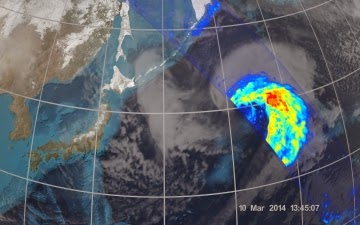
NASA and the Japan Aerospace Exploration Agency (JAXA) have released the first images captured by their newest Earth-observing satellite, the Global Precipitation Measurement (GPM) Core Observatory, which launched into space Feb. 27.

The images show precipitation falling inside a March 10 cyclone over the northwest Pacific Ocean, approximately 1,000 miles east of Japan.


On March 10, the Core Observatory passed over an extra-tropical cyclone about 1,055 miles (1,700 kilometers) due east of Japan's Honshu Island. Satellite data shows the full range of precipitation in the storm.

Image Credit: NASA's Goddard Space Flight Center

Russian-US ISS crew blast off from Kazakhstan - Arrival Delayed

A crew of two Russian cosmonauts and an American astronaut blasted off Tuesday from Kazakhstan on a Russian Soyuz rocket for the International Space Station, with US-Russia space cooperation continuing amicably, despite the diplomatic standoff over Ukraine.

Russians Alexander Skvortsov and Oleg Artemyev along with Steve Swanson of NASA took off in a spectacular night-time launch at the start of a fast-track six-hour journey to the orbiting laboratory, where they will spend half a year.

All the stages of the launch went without a hitch and the Soyuz capsule successfully went into the correct orbit.

Docking with the ISS was expected at 03:04 GMT Wednesday but this has been delayed until 07:58 Thursday.

After the retirement of the US shuttle, NASA is for now wholly reliant on Russia for delivering astronauts to the space station on its tried-and-trusted Soyuz launch and capsule system.

Space officials have made clear that space cooperation, one of the few areas of genuine mutual work between Russia and the United States, will continue unaffected by the mounting diplomatic strains that have seen the US impose sanctions on Russian officials over Moscow's seizure of Crimea.

A yellow toy duck nicknamed "quack" given to Swanson by his daughter hung in the cockpit and started floating a few minutes into launch as the crew started to experience weightlessness.

-'We'll live together peacefully'-

Arrival Delayed
The next trio of crew members destined for the International Space Station is now looking forward to a Thursday arrival at the orbiting laboratory after their Soyuz spacecraft was unable to complete its third thruster burn to fine-tune its approach. 

Flight controllers in the Mission Control Center outside Moscow are now reverting to a backup 34-orbit rendezvous, which would result in an arrival and docking at 7:58 p.m. EDT Thursday, March 27.

Tuesday, March 25, 2014

NASA MODIS: Agricultural fires across Sierra Leone

Credit: NASA image courtesy Jeff Schmaltz, MODIS Rapid Response Team.

Marked in red, hundreds of land use fires burn in the fields across Sierra Leone.

Most fires in this region are deliberately set for a variety of reasons, including slash and burn agriculture.

When a plot of land becomes exhausted, farmers shift cultivation to another plot where they cut the trees and brush at the beginning of the dry season in January and February.

Once the dead plant material has dried, they set fire to it. Such fires peak in March and April right before farming season begins.

From space, MODIS detects thermal anomalies, including fires, flares, and volcanoes.

Each MODIS "fire pixel" or fire detection covers one square kilometer, which means that one or more fire is burning in the corresponding one-square kilometer area on the ground.

There are hundreds of fire pixels evident in this image, so there are at least that many distinct fires burning in this scene.

MODIS tends to undercount fires because it can't detect fires through smoke or clouds, nor does it see small cool fires, a fire type common to land use fires.

Where there is fire, there is also smoke, affecting air quality. Smoke contains soot and other particulates that pose a threat to human health and affect regional climate. Burning also releases greenhouse gases.

This natural-colour satellite image was collected by the Moderate Resolution Imaging Spectroradiometer (MODIS) aboard the Aqua satellite on March 24, 2014.